





Saturated Subgrades in Pavements: Causes, Structural Consequences, and Solutions Using Geosynthetics.
The presence of water in the layers that make up a pavement’s structure is one of the factors that can significantly compromise its performance and service life. When the subgrade becomes saturated—especially in fine-grained, low-permeability soils—this can lead to a reduction in its bearing capacity, an increase in permanent deformations, and a loss of stability under the repetitive action of traffic.
This condition can be caused by high water tables, surface water infiltration, deficiencies in drainage systems, or water accumulation within the granular layers. If not properly controlled, it can lead to rutting, fine-grained material heaving, differential settlement, and premature deterioration of the pavement surface.
In light of this problem, geosynthetics offer various solutions through their separation, filtration, reinforcement, and drainage functions. Notable among these are high-modulus woven polyester geotextiles and subdrainage systems consisting of flat geodrains and perforated pipes, which address both the mechanical and hydraulic conditions of the soil.
Why do subbases become saturated?
Subgrade saturation occurs when water fills the voids in the soil, reducing or eliminating the air present within them. This phenomenon can be associated with various hydrogeological and construction-related conditions:
-
High water table:
When groundwater is close to the pavement structure, capillary rise or water infiltration into the lower layers may occur.
-
Surface water infiltration:
Cracks, joints, unprotected curbs, and deficiencies in surface drainage facilitate the entry of rainwater.
-
Poor drainage:
The lack of drainage systems, inadequate slopes, or materials with poor drainage capacity contribute to water accumulation.
-
Low-permeability soils:
Subgrades composed of clay and silt may have difficulty draining water, thereby prolonging periods of saturation.
-
Construction defects:
Inadequate compaction, construction under unfavorable moisture conditions, and a lack of protection for the subgrade can increase the soil's susceptibility to deterioration.
Identifying the source of the water is the first step in selecting an appropriate solution, since it is not enough to install reinforcement materials if the conditions causing the saturation persist.
Structural Consequences of a Saturated Subgrade
An increase in water content alters the mechanical behavior of the materials that make up the road structure. The magnitude of these effects depends on the soil’s characteristics, its plasticity, density, confinement conditions, and stress regime.
Among the main consequences are:
-
Reduced support capacity:
In fine-grained soils, increased moisture content can reduce shear strength and the modulus of elasticity, thereby reducing the subgrade's ability to withstand traffic loads.
-
Increase in permanent deformations:
Under repetitive loads, a weakened subgrade may experience greater deformations, leading to the development of rutting and differential settlement.
-
Contamination of granular layers:
The migration of fine particles from the subgrade to the subbase can alter the particle size distribution of the aggregates, reduce their permeability, and affect their structural capacity.
-
Pumping of fines:
The repetitive action of loads, in the presence of water and hydraulic gradients, can cause fine particles to migrate toward the upper layers.
-
Challenges during construction:
The movement of machinery over saturated soil can cause instability, deformation, and difficulties in achieving the specified compaction conditions.
For this reason, water control and the preservation of the integrity of the granular layers must be considered fundamental aspects of pavement design and construction.
Geosynthetic Solutions for Saturated Subgrades
The selection of a solution must be based on the geotechnical characteristics of the site and traffic conditions. Geosynthetics make it possible to develop different intervention mechanisms that can be combined within a single structure.
-
High-modulus woven polyester geotextiles: separation, filtration, and reinforcement
High-modulus woven polyester (PET) geotextiles improve the performance of road structures built on subgrades with low bearing capacity, thanks to their high tensile strength and low deformation.
Its incorporation between the subgrade and the subbase layer enables it to perform the following main functions:
-
Separation:
It prevents the fine soil of the subbase from mixing with the aggregates in the granular layers, thereby preserving the integrity and properties of the materials that make up the structure.
-
Reinforcement:
Thanks to its high tensile modulus and its interaction with the granular material, it helps mitigate permanent vertical deformations and improve the distribution of stresses on the subgrade.
In addition, high-modulus woven polyester (PET) geotextiles have excellent hydraulic properties and open area, which enable them to perform a filtration function by allowing water to pass through while limiting the migration of particles.
High-modulus woven polyester geotextiles are a particularly useful alternative for improving the stability of road structures on sites with low bearing capacity and unfavorable construction conditions.
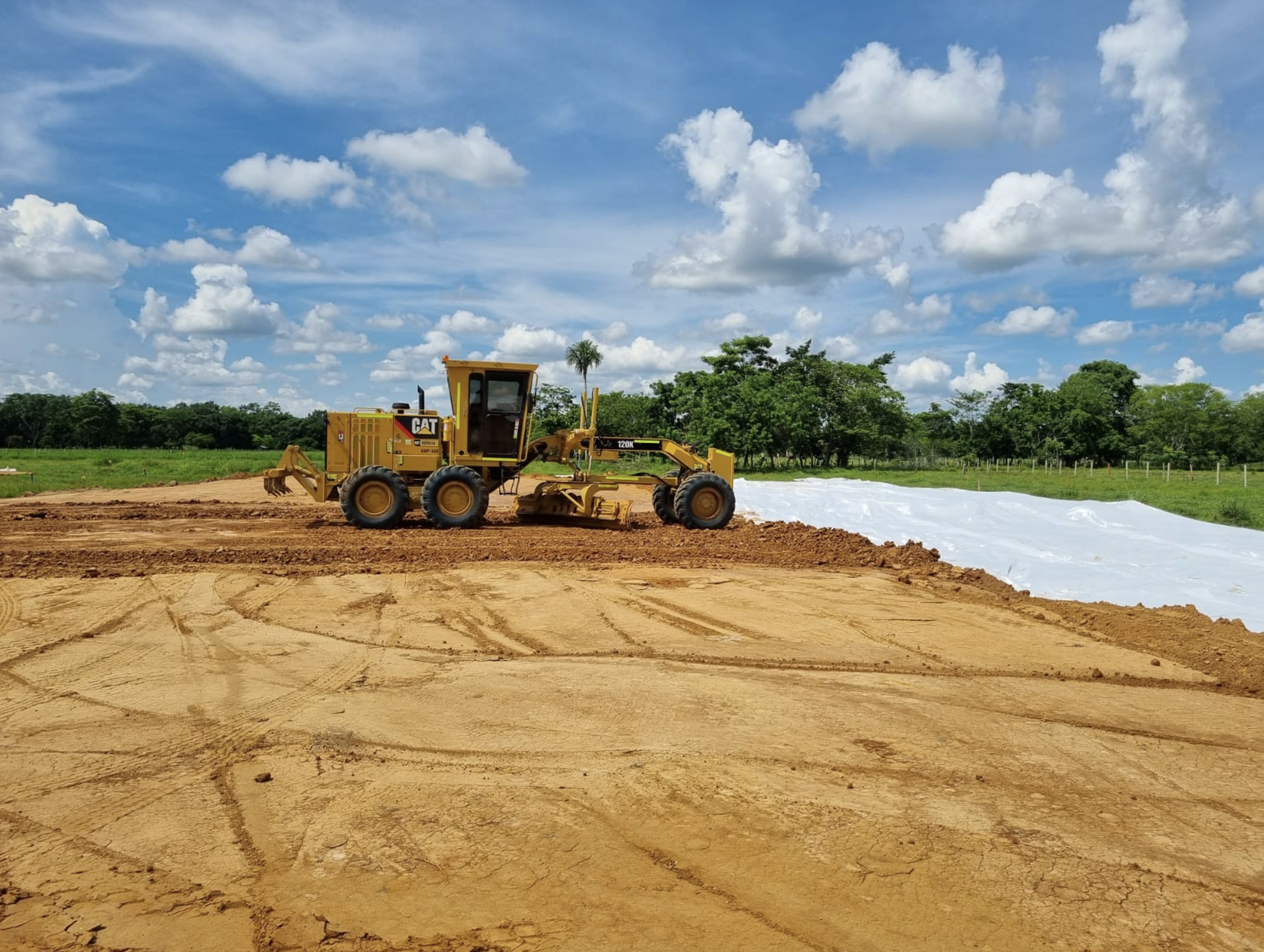
Photo 1. Installation of FORTEX high-modulus woven geotextile (PET) for subgrade reinforcement
-
Subsurface drainage systems using flat geodrains and perforated pipe
When groundwater accumulates or seeps into the road structure, subdrainage systems allow the flow to be collected and discharged in a controlled manner. One alternative is to install flat geodrains connected to perforated pipes.
Flat geodrains collect and convey water across their surface, while perforated pipes receive the flow and transport it to a discharge point. These systems can be installed in longitudinal trenches or on the sides of the road structure, reducing the need for large volumes of granular material.
Its proper operation depends on the hydraulic design, the transmission capacity, the slope of the pipes, and the availability of discharge points that ensure the water is drained.
Conclusions
Saturated subgrades affect the bearing capacity and stability of pavements. Treating them requires identifying the source of the water and implementing solutions that control moisture and improve soil conditions. In this context, high-modulus woven PET geotextiles serve as separation, reinforcement, and filtration layers. Meanwhile, planar geodrains and perforated pipes allow water to be collected and drained. Their integration through proper design helps improve the performance and durability of road structures.