





Biaxial Polyester Geogrids vs. Traditional Solutions for Crack Control in Asphalt Pavements
Cracks are one of the most common forms of deterioration in flexible pavements, and when not properly managed, they can progress to the point of compromising the structure’s performance and service life. To address this issue, there are various rehabilitation and maintenance options. Traditional solutions include crack sealing, surface treatments, and the application of new layers of asphalt mix. However, when it is necessary to slow the spread of cracks and improve the performance of an overlay, biaxial polyester geogrids offer a reinforcement option that can be integrated into the pavement system.
Why do cracks form in asphalt layers?
Before selecting a solution, it is essential to identify the mechanism causing the deterioration.
Cracks in a pavement can result from fatigue associated with repeated vehicle loads or asphalt aging; thermal cracks, related to temperature cycles; or reflected cracks, which originate in an existing layer and subsequently propagate into the new asphalt surface.
In rehabilitation projects, applying a new overlay does not necessarily eliminate the problem. The causes of the cracks may reappear and gradually spread through the new layer.
For this reason, crack control must be addressed by considering both the characteristics of the asphalt mix and the behavior of the layers that make up the structure.
Traditional Solutions for Controlling Cracks
Conventional methods remain important tools for pavement maintenance and rehabilitation.
- Sealing cracks prevents water from entering and reduces the deterioration associated with water infiltration; it is a suitable alternative when the cracks are localized and in a condition that allows for treatment.
- Surface treatments can also be used to improve waterproofing and protect the existing surface from the effects of traffic and the environment.
- Another common strategy involves applying an overlay of asphalt concrete. Increasing the thickness can improve structural capacity, but its effectiveness against reflected cracks depends on the condition of the existing pavement and the mechanism causing the deterioration. In other words, increasing the thickness of the asphalt layer does not always mean that the problem of crack propagation has been solved.
How do biaxial polyester geogrids work?
Biaxial polyester geogrids are reinforcement elements consisting of a high-strength structure in two principal directions. (see Figure 1). When incorporated into rehabilitation overlay layers—properly designed and installed—they help distribute stresses and contribute to controlling the deformations associated with crack propagation.
Its function is related to the reinforcement's ability to redistribute tensile and shear stresses within the layer, creating a mechanical barrier against the rapid propagation of certain types of cracks.
It is important to clarify that geogrids do not transform an asphalt layer into a system that is completely free of cracks. Their function is to delay the appearance or propagation of cracks and improve the system’s performance, provided there is compatibility between the type of reinforcement, the asphalt mix, the condition of the pavement, and the failure mechanism.
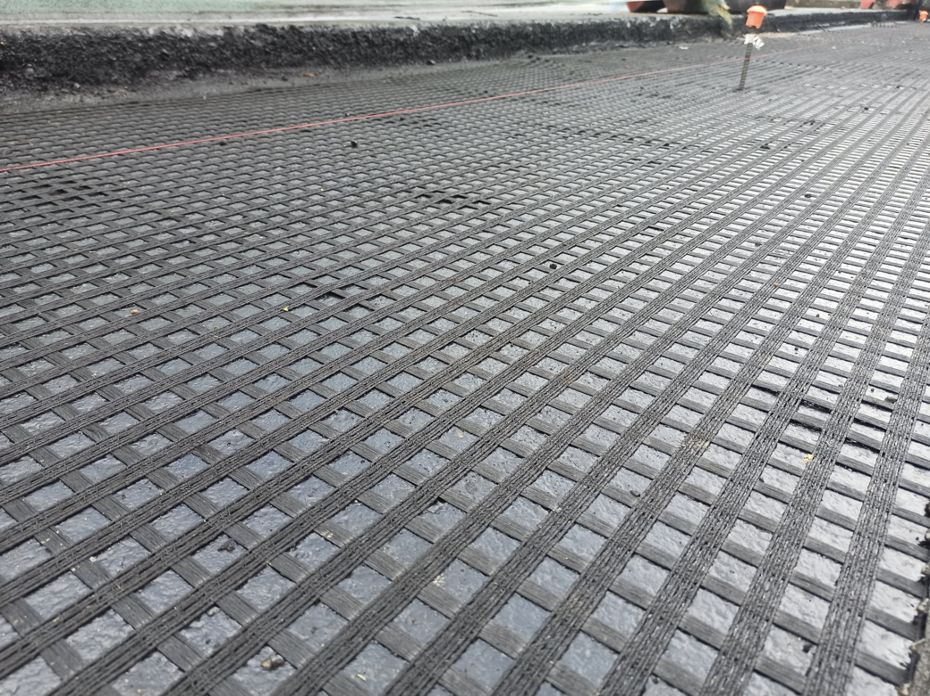
Figure 1. Woven Biaxial Polyester Geogrid Fortgrid Asphalt installed
Biaxial Polyester Geogrid vs. Traditional Solutions
The main difference between incorporating a polyester geogrid into asphalt layers and using only a conventional solution lies in the role that each alternative plays.
CRITERIA |
TRADITIONAL SOLUTIONS |
BIAXIAL POLYESTER GEOGRID |
| Treatment of Existing Cracks | You can seal them or cover them | It provides an extra boost that helps slow its spread |
| Structural Reinforcement | Generally limited to an increase in thickness | Related to the performance of the reinforcing geogrid within the layer |
| Spread Control | It is limited by the shear strength of the new overlay, which is limited. | It causes a redistribution of forces that delays the formation of cracks |
| Interaction with the pavement | It acts primarily on the surface or by forming a new layer | Works seamlessly with the reinforced layer |
| Expected result | Protection, waterproofing, or surface restoration | Prevents cracking, thereby ensuring that the new layer remains waterproof for a longer period and making it easier to perform maintenance work |
This comparison, however, should not be interpreted as an automatic substitution of one solution for another. In many projects, the best strategy may be precisely to combine traditional interventions with a geogrid reinforcement system.
When might it be appropriate to use a geogrid?
Biaxial polyester geogrids may be particularly useful in projects where there is a significant risk of reflected cracking or where the goal is to improve the performance of a rehabilitated asphalt layer.
They can also be evaluated when the goal is to achieve greater cross-sectional efficiency through a reinforcement system that optimizes the structure's performance, always based on a design that takes into account the actual pavement conditions.
In these cases, it is essential to correctly determine the location of the reinforcement within the asphalt structure, ensure proper adhesion between the layers, and follow the installation specifications for the system being used.
The Importance of Design and Installation
The performance of a geogrid does not depend solely on its nominal strength. The selection process must take into account variables such as the type of existing pavement, the condition of the surface, the cracking mechanism, the characteristics of the asphalt mix, the bond between layers, and traffic loads.
In addition, proper installation is essential. Surface preparation, the application of the binder or bonding system, the handling of the geogrid, and the correct placement of the asphalt mix are all factors that can significantly influence the final performance.
For this reason, the use of geogrids should be part of a comprehensive rehabilitation solution and should not be considered in isolation.
An alternative for increasing the durability of the pavement
A biaxial polyester geogrid provides a reinforcement mechanism that conventional solutions—which rely solely on surface treatments or increased thickness—do not offer to the same extent.
The main advantage is that the geogrid integrates into the asphalt layer and helps redistribute stress and slow the spread of cracks, thereby helping to preserve the surface's functionality for a longer period of time.
The choice between a traditional solution and a biaxial polyester geogrid should not be viewed solely as a matter of materials, but rather as an engineering decision. Analyzing the cause of the cracks, the pavement conditions, and the loads to which the structure will be subjected allows for the determination of the most appropriate rehabilitation strategy.