





Biaxial geogrids: reinforcement in granular layers of pavements
1. Reinforcement effect
biaxial geogrids FORTGRID BX are commonly installed at the interface between the base and the subbase, between the subbase and the subgrade, or within the granular base itself. This significantly reduces the stresses transmitted to the subgrade compared to unreinforced sections (Figure 1).
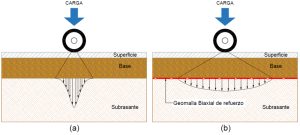
Comparison of loads transmitted to the subgrade in (a) unreinforced pavement and (b) geogrid reinforced pavement (According to Zornberg, J.G., 2013).
In practice, geogrid reinforcement improves the load-bearing capacity and service life of the pavement, reduces the thickness of granular layers and reduces environmental impact.
2. Reinforcement mechanism
geogrids FORT effectively interact with the granular material generating restriction to the lateral displacement of particlesThis increases the stiffness and stability of the system. As a result, the response of the pavement to repeated loading is improved, represented quantitatively through parameters such as the Traffic Benefit Ratio (TBR) and the Base-Course Reduction Ratio (BCR).
The effect of geogrid reinforcement is explained by the following reinforcement mechanisms:
a. Increased bearing capacity
The geogrid modifies the original failure surface, creating an alternative surface contained between the granular layer and its interface. This substantially improves the bearing capacity (Figure 2).
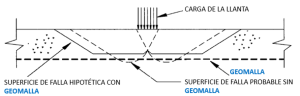
Effect of geogrid reinforcement on the bearing capacity of the system.
b. Lateral displacement restriction
He hindering (interlock) causes the aggregate particles to be confined in the openings of the geogrid, limiting their mobility when loads are applied. Therefore, this mechanism generates a confinement that opposes the appearance of lateral shear flows that result in a better stress distribution and less deformationThis is because it induces a permanent compression condition in granular materials, which are typically stress-dependent. This behavior is illustrated in (Figure 3).
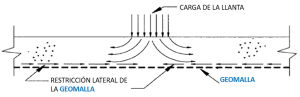
Figure 3. Lateral displacement constraint generated by particle confinement.
The performance of the above reinforcement mechanism is done through the measurement of benefit factors such as TBR and BCR as explained below:
3. Performance indexes: TBR and BCR
- Traffic Benefit Ratio (TBR)
This factor, which quantifies the improvement in performance, is measured as the ratio between the number of load cycles that a pavement section with a granular base reinforced with geogrid versus an unreinforced section, required to reach an equivalent level of deterioration (see Figure 4).
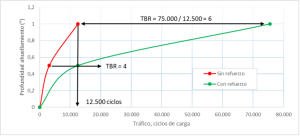
Figure 4. Comparison of the performance of reinforced and unreinforced structures using TBR (Perkins, 1999).
- Base-Course Reduction Ratio (BCR)
This factor allows evaluating the reduction in the thickness of the granular layer required to achieve equivalent performance when using geogrid reinforcement.
- Cyclic stress modulus
The efficiency of the geogrid as a long-term reinforcement element is measured by its ability to tolerate cyclic loading. For this purpose, ASTM committee D35 generated the test D7556 Modulus in Cyclic Tension, which assesses the ability of the geogrid to sustain its reinforcement capacity throughout the life of the pavement, represented in a scenario of permanent deformations.
Thanks to their design and materiality, the geogrids FORTGRID BX maintain a modulus of constant stiffness under cyclic loadingeven in the face of permanent deformations. This behavior ensures a sustained contribution of the reinforcement throughout the service life of the pavement, significantly reducing accumulated deformations and preserving serviceability. Compared to polypropylene biaxial and multiaxial extruded geogrids, FORTGRID offers a higher elastic recovery capacity, as shown in Figure 5.
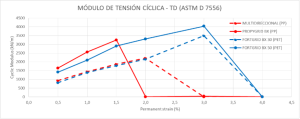
Cyclic modulus of stiffness results (ASTM D 7556).
4. Advantages of reinforcing granular layers with FORTGRID BX geogrids
Soil reinforcement with biaxial geogrids FORT offers multiple advantages that optimize the structural performance of pavements, among which the following stand out:
- Significant increase in bearing capacity of the subgrade in the projected pavement structure.
- Effective deformation control induced by dynamic loads, which favors the durability of the pavement.
- Improved elastic resilienceThe high modulus of stiffness in cyclic loading of the geogrid reduces the progressive deterioration of the pavement.
- Decreased modulus loss of granular materialThe structural performance of the system is prolonged, in other words, the rate of loss of serviceability is reduced.