





Reinforced Earth Walls vs. Reinforced Concrete Walls: Which Is the Best Option for Your Project?
Retaining structures play a fundamental role in the construction of roads, bridges, residential developments, and other infrastructure projects, as they stabilize slopes, contain fill material, and provide safe platforms for project development. The choice of the appropriate retaining system directly affects the project’s cost, construction time, structural performance, and maintenance costs over its service life.
Among the most commonly used alternatives are reinforced soil walls and reinforced concrete walls. Although both serve to contain the soil, their behavior, construction process, and performance are very different. The following is a comparison of these two solutions to help you select the most suitable option.
What is a reinforced soil wall?
A reinforced soil wall (MSE – Mechanically Stabilized Earth) is a retaining structure consisting of a mass of compacted soil reinforced with high-strength elements, such as geogrids, that work together to resist lateral earth pressures. The facade can consist of precast concrete panels, segmental blocks, or green solutions, depending on the project’s requirements.
Thanks to its flexible behavior, this type of wall performs exceptionally well under differential settlement and seismic loads, which is why it is widely used in highways, bridges, highway interchanges, railroads, and high-rise infrastructure projects.
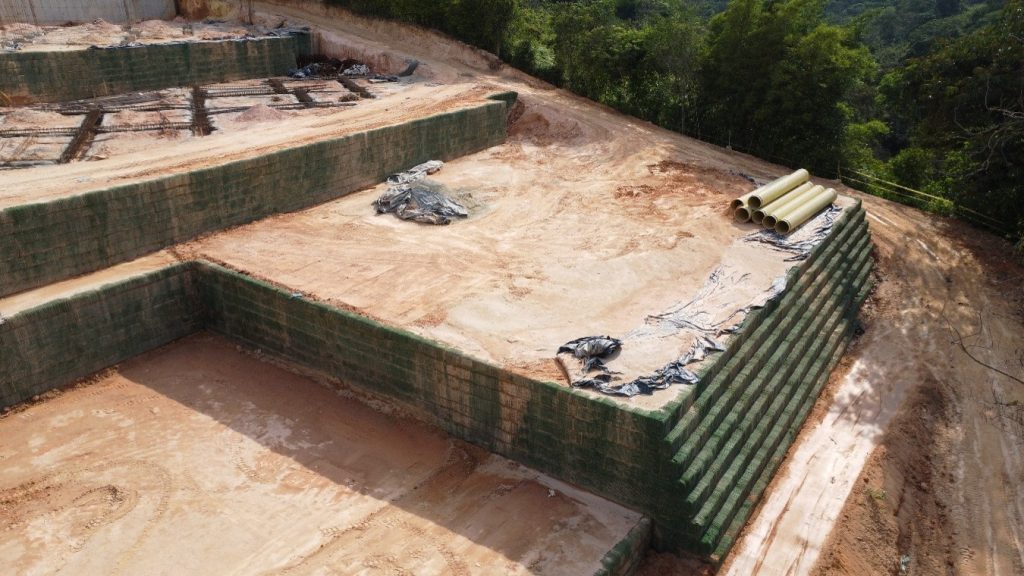
Figure 1. Wall on reinforced ground
What is a reinforced concrete wall?
A reinforced concrete wall is a rigid structure built of concrete and reinforcing steel, designed to resist earth pressure through its resistance to bending and shear. Depending on the project conditions, it can be designed as a cantilever wall, a buttressed wall, or a gravity wall.
It is frequently used in urban and infrastructure projects where deformation must be minimized and there is sufficient space to construct high-capacity foundations. Although it offers high structural strength, its rigid behavior makes it more susceptible to differential ground settlement and seismic events.
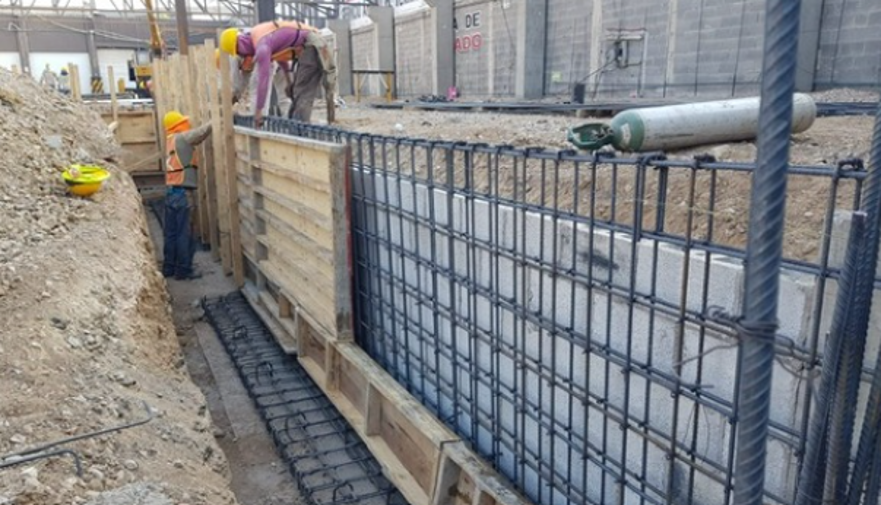
Image 2. Concrete wall
Comparison of the Two Systems
Construction Costs
One of the factors that most influences the selection of a retaining system is the construction cost. In most infrastructure projects, reinforced earth walls are more cost-effective when the height exceeds approximately three meters.
This advantage stems from the fact that they essentially do not require concrete or reinforcing steel, reduce the need for deep excavations, and allow for the construction of simpler foundations. Furthermore, in many cases, it is possible to use some of the material from the excavation as structural backfill, thereby significantly reducing transportation and disposal costs.
In contrast, reinforced concrete walls require the use of these materials, as well as formwork, skilled labor, and larger foundations to ensure stability against overturning and sliding.
Depending on the project conditions, a reinforced earth wall can result in savings ranging from 15 % to 40 % compared to a conventional concrete wall.
Construction time
Construction time is another major advantage of reinforced concrete flooring. Building a concrete wall requires several consecutive steps, such as installing rebar, erecting formwork, pouring concrete, and allowing time for curing before proceeding to the next stages. These processes significantly extend the duration of the project.
In contrast, reinforced soil walls are constructed in successive layers of compacted fill and geogrids, with the wall’s facing installed simultaneously. This procedure allows for continuous progress, eliminates the downtime associated with concrete, and facilitates much faster construction.
In linear projects, such as roads or bridge approaches, this difference can translate into weeks or even months of savings on the construction schedule.
Structural Performance
Although both systems are designed to support the soil, their structural behavior is completely different.
Reinforced concrete walls
Reinforced concrete walls function as rigid structures that resist soil thrust through the strength of the concrete and steel. This rigidity limits deformation, but it also makes the structure more susceptible to cracking when differential settlement or ground movement occurs.
Reinforced soil walls
Reinforced soil walls, on the other hand, function as an integrated system in which the soil and geogrids form a single, strong unit. This interaction allows for better load distribution and the absorption of deformations without compromising the stability of the structure.
Thanks to this flexible behavior, reinforced soil walls perform exceptionally well under dynamic loads, vibrations, and seismic events, making them one of the most widely used solutions in countries with high seismic activity.
It should also be noted that in many cases the two solutions are combined, as is the case with bridge abutment walls, where soil-reinforced walls are typically placed behind the concrete structure to reduce thrusts and thus achieve more economical structures, or embankment foot retaining walls, where concrete walls are built at the base and then extended upward with reinforced soil walls or steeply sloped reinforced soil embankments until the crest elevation is reached.
Maintenance
Maintenance is an important aspect throughout the service life of any retaining structure.
In reinforced concrete walls, it is common for cracks to appear over time due to shrinkage, differential movement, or deterioration caused by steel corrosion when drainage problems exist. These defects may require periodic repairs to ensure the structure’s durability.
For reinforced soil retaining walls, maintenance is typically minimal and focuses primarily on inspecting the facade and verifying that the drainage system is functioning properly. When the geotechnical and hydraulic design is appropriate and high-quality materials are used, these structures require little intervention during their service life, and in the vast majority of cases, native vegetation takes root, covering the facade and blending naturally into the landscape.
Adaptation to Settlements
One of the main advantages of reinforced flooring is its ability to adapt to natural ground movements.
Because of its flexible behavior, this type of wall can withstand differential settlement without sustaining significant structural damage, making it an excellent alternative for soft soil or soil with low bearing capacity.
In contrast, reinforced concrete walls are less tolerant of this type of deformation and may develop cracks or even have their stability compromised when settlement exceeds the values specified in the design.
It is noted that the construction process for reinforced soil walls involves the gradual application of load to the soil, with the possibility of making adjustments as construction progresses, which represents a significant practical advantage.
Environmental Impact
Sustainability is an increasingly important criterion in modern engineering.
Reinforced soil walls have a lower environmental impact because they reduce or eliminate the use of concrete and steel—materials whose production accounts for a significant portion of the construction sector’s carbon dioxide emissions. In addition, they allow for the reuse of excavated materials and reduce the need to transport construction materials.
Reinforced concrete walls, while highly durable, require larger volumes of materials and consume more energy during the construction process.
| Appearance | Walls on Reinforced Ground | Reinforced Concrete Walls |
| Construction Cost | Generally lower for medium and tall heights. | Higher due to the use of concrete, steel, and foundations. |
| Runtime | Fast and continuous, with no curing time. | Slower due to the process of mixing, pouring, and curing the concrete. |
| Material consumption | Lower consumption of concrete and steel, and in some alternatives, their complete elimination. | High consumption of concrete, steel, and formwork. |
| Structural Behavior | Flexible; adapts to deformations and settlement. | Rigid, with less tolerance for ground movement. |
| Seismic Performance | Excellent because of its flexibility. | Well, although it depends on proper structural design. |
| Maintenance | Basement; mainly inspection of drains and the exterior wall. | Moderate; repairs may be needed due to cracking and corrosion. |
| Environmental Impact | A smaller carbon footprint and the ability to reuse materials. | Higher resource consumption and emissions during construction. |
Table 1. General Comparison
Which system should you choose?
The choice between a reinforced soil wall and a reinforced concrete wall will depend on the specific characteristics of the project. If the goal is to optimize costs, reduce construction time, and achieve better performance in the face of settlement and seismic events, reinforced soil is usually the most efficient option.
On the other hand, reinforced concrete walls remain a suitable solution when available space is limited, heights are moderate, or the project requires a structure with highly controlled deformations.
In any case, the decision must be supported by a geotechnical study and a structural design that take into account the ground conditions, the applied loads, the expected service life, and the life-cycle cost of the structure.
Conclusion
Advances in geotechnical engineering have made reinforced earth walls one of the most efficient solutions for modern infrastructure projects, thanks to their lower cost, rapid construction, excellent seismic performance, and ability to adapt to ground deformations.
However, reinforced concrete walls remain a reliable alternative in projects where rigid structures are required or specific geometric constraints exist. Rather than competing with each other, both systems represent complementary solutions, and the choice between them should be based on technical, economic, and construction-related criteria.
A comprehensive analysis beginning at the design stage will allow us to select the option that offers the best balance between safety, durability, functionality, and cost, ensuring the structure’s proper performance throughout its service life.
References
- FHWA. Mechanically Stabilized Earth Walls and Reinforced Soil Slopes Design and Construction Guidelines (FHWA-NHI-10-024).
- AASHTO. LRFD Bridge Design Specifications, latest edition.
- SEND. General Specifications for Road Construction.
- Koerner, R. M. Designing with Geosynthetics. 6th Edition.
- BS 8006-1:2010. Code of Practice for Strengthened/Reinforced Soils and Other Fills.