





The errors that most significantly affect the performance of a reinforced earth wall
The reinforced soil walls They have established themselves as one of the most efficient solutions for slope stabilization, road widening, and infrastructure projects. Their speed of construction, flexibility, and cost-effectiveness make them an increasingly popular alternative to traditional concrete walls.
However, there is one aspect that is often underestimated during the project's implementation: the quality of the construction process.
Even a properly designed wall can experience excessive deformation, differential settlement, or a loss of performance if proper procedures are not followed during construction. In these types of structures, each subdrain element, each layer of compacted soil, and each reinforcement element work together to form a stable system; therefore, small errors repeated during construction can become significant problems over time.
Below, we present the structural factors that most influence the performance and durability of a wall on reinforced soil.
The handling and storage of the geosynthetics begins before construction starts
One of the first mistakes that can compromise the quality of the project occurs even before the first roll of geosynthetic is laid.
Materials should be stored on clean, flat, and dry surfaces, protected from the elements. When storing outdoors, it is recommended to raise the rolls off the ground and cover them to prevent moisture and prolonged exposure to UV rays. In addition, retaining the identification labels facilitates traceability and quality control throughout the entire project.
Although geosynthetics are highly durable, improper storage can affect their condition before installation.
A proper foundation is the key to success
Before beginning construction, it is essential to excavate to the design elevation, inspect the site, and verify that the foundation soil meets the conditions specified in the design.
If soft, organic, or unexpected materials are encountered during excavation, they must be replaced with screened and compacted material before work continues.
The stability of the entire structure depends on this first stage.
The orientation and installation of the reinforcement make all the difference
The geosynthetic must not only be placed in the position indicated on the drawings; it must also be installed correctly.
During construction, it is important to temporarily secure it to prevent it from shifting while the fill material is being placed and to keep it properly tensioned.
In addition, the geosynthetic’s principal direction of resistance must be perpendicular to the wall face, allowing the reinforcement to utilize its full structural capacity in the direction of the principal stress.
When overlaps are required, they must be placed parallel to the main direction of resistance and never in the direction in which the wall is likely to slide. The installation guide recommends an approximate width of 20 cm to ensure the continuity of the reinforcement system.
Compaction: probably the most important factor
If there is one factor that determines the performance of a wall in reinforced soil, it is compaction.
The fill material must be placed in controlled layers, generally no more than 25 cm thick, to ensure that each layer can be properly compacted until the minimum required density is achieved.
The type of equipment also affects performance
Another important factor is the type of equipment used.
In the area near the facade, lightweight equipment, such as vibratory plates or impact compactors, should be used to avoid transmitting excessive forces that could deform the front of the wall. Heavy compaction equipment should only be used at a sufficient distance from the facade.
Inadequate compaction leads to greater deformations, reduces soil-reinforcement interaction, and diminishes the system's structural capacity.
Humidity control is essential
During construction, it is equally important to ensure that the subgrade is not exposed to heavy rain before or after placement, as this hinders construction processes and affects the performance of the layers that have already been placed.
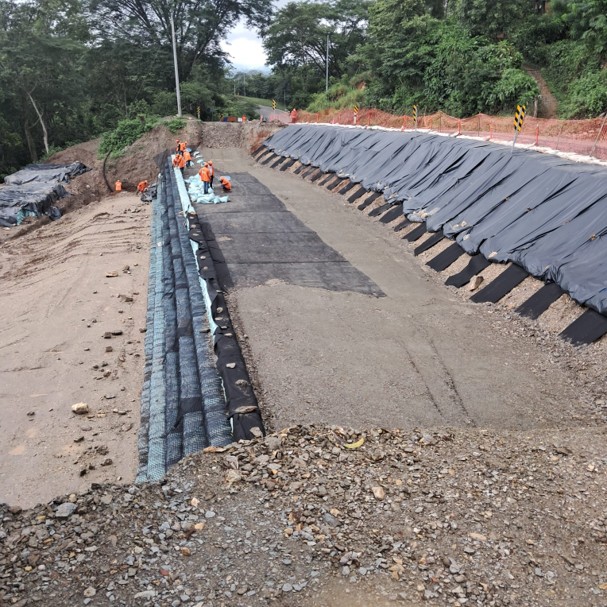
Figure 1. Wall on reinforced ground during the construction phase.
A well-constructed facade improves the wall's performance
The facade serves more than just an aesthetic purpose.
During construction, it is important to ensure that each layer is properly sealed and that the material remains contained.
When geogrids are used as a reinforcing element, it is advisable to incorporate a woven geotextile on the surface to prevent soil migration through the openings in the geogrid, thereby preserving the stability of the facade and improving its long-term performance.
Another important consideration is the control of runoff, which must not wash over the face of the wall, as this can cause erosion. It is recommended that the ground slope at the top of the wall slope backward and that appropriate systems be in place to collect and manage this runoff. Similarly, depending on the type of structure installed at the top of the wall, it is advisable to install a waterproofing system that controls vertical seepage flows into the backfill soil.
Drainage should not be left until the end
One of the main threats to any retaining structure is water.
The accumulation of water within the backfill increases internal pressures and reduces the soil's strength, directly affecting the stability of the wall.
For this reason, the project must incorporate systems that allow for the collection and drainage of both surface water and groundwater, while maintaining the mechanical properties of the fill material throughout the structure’s service life.
Installing proper subdrainage systems usually represents a minimal investment compared to the potential cost of repairs.
Conclusion
The performance of a reinforced earth wall does not depend solely on a sound geotechnical design. Proper construction on-site is equally critical to ensuring its stability, durability, and long-term performance.
Factors such as the proper storage of geosynthetics, the preparation of the subgrade, the correct installation of the reinforcement, compaction control, the proper shaping of the face, and an efficient drainage system form a chain of processes in which each stage directly influences the next.
Implementing best construction practices reduces risks, optimizes the structure's service life, and allows you to take full advantage of the benefits offered by reinforced floor systems.