

Elevated tank in Cajamarca with Fortgrid BX geogrids
The Provincial Municipality of Cajamarcain alliance with SEDACAJ and Newmonthas developed an important water infrastructure project on the outskirts of the city. This is a 1,100 m³ elevated tanklocated in the area of the Qhapaq Ñanwhich supplies potable water to more than 20,000 inhabitants.
This project faced major geotechnical challenges, which were solved through the use of Fortgrid BX biaxial geogridsa modern solution for foundations on clayey soils with low bearing capacity.
Their main characteristics are summarized below:
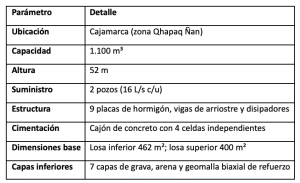

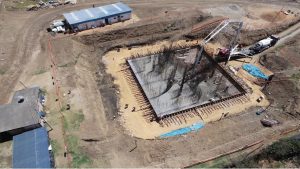
Figure 1: Elevated tank of the Qhapaq Ñan tubular well in Cajamarca.
Geotechnical problems in Cajamarca
The area has soft clayey soilsclassified as type CL, with low bearing capacity and high compressibility. These factors increase the risk of differential settlementsespecially under heavy structures such as this tank.
The studies identified:
-
Low friction angles (13-15°)
-
High deformability
-
Risk of instability during earthquakes
Therefore, the design required foundation soil reinforcement.
ENGINEERED FOUNDATIONS AND GEOTECHNICAL CHALLENGES
The designed foundation consists of a reinforced concrete caisson divided into four independent compartments (for stability monitoring). For the support, the natural soil was removed and replaced by seven layers of a sandy gravelly granular material interspersed with layers of high-strength biaxial geogrid, thus reducing the compressibility of the soil and increasing the bearing capacity. The lower foundation slab is 462 m² and the upper slab is 400 m². This system seeks to create a wide and stable base under the tank.
Applied solution: Fortgrid BX geogrids
In order to mitigate the risks of the terrain, a system of biaxial geogrids Fortgrid BX between layers of granular material. This system allows:
Main reinforcement mechanisms:
-
Lateral entrapment: The gravel is anchored in the mesh openings, generating friction and resistance to displacement.
-
Membrane effect: the geogrid acts as a tensioned membrane that redistributes the vertical load.
-
Increased bearing capacity: the active support zone expands, decreasing the fault depth.
This solution works as a "snow shoe"The load is distributed over a wider and firmer base.
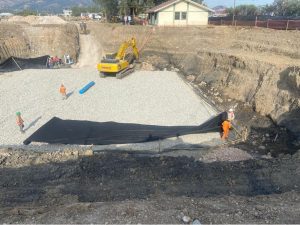
Fortgrid Bx geogrids stabilize compressible soils by exerting several actions: confining granular particles and preventing their lateral displacement, transferring frictional loads at the soil-geogrid interface and acting as a tensioned membrane under load. These properties control settlement and increase the bearing capacity of the foundation, compensating for the poor quality of the natural bearing soil.
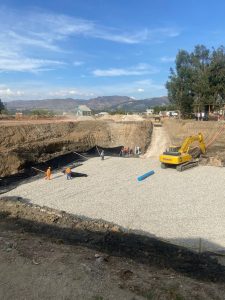
Geogrid reinforcement mechanisms
The main reinforcement mechanisms generated by the geogrid are as follows FORTGRID BX are:
- Lateral embedment of the backfill: The gravel particles are embedded in the openings of the geogrid, creating a mechanical interlock that resists horizontal displacement of the soil. This "passive anchoring" increases the stiffness of the soil-geogrid assembly. Additionally, the rough surface of the geogrid generates friction with the soil, transferring load to the geosynthetic. Both effects combined increase the shear strength of the granular backfill.
- Tensioned membrane effect: Under a vertical load the soil-geogrid system yields forming a downward curvature. The geogrid, due to its high tensile stiffness, is tensioned like a membrane and exerts an upward vertical support force. This phenomenon redistributes the loads towards the edges of the caisson, reducing the vertical deformations on the soft subgrade.
- Increased bearing capacity: Together, lateral reinforcement and the membrane effect cause the active failure zone to expand laterally and decrease in depth. This significantly increases the bearing capacity of the foundation-soil system. As a result, expected settlements are reduced, permanent deformation is reduced and the response to seismic loads is improved.
These mechanisms allow the tank to be supported on originally unsuitable ground. FORTGRID BX geogrid functions analogously to a "snow shoe" that spreads the load over a wide granular base. This results in a more stable and secure base.
EXPECTED RESULTS
After the implementation of the geogrid reinforcement, a much more stable foundation and a significant reduction of differential settlements are expected. Field studies and simulations indicate that the reinforced soil will show less subsidence under load, thanks to the confinement provided by the mesh. In practice, the use of FORTGRID BX saves material: by increasing stiffness, thinner granular layers can be used, reducing backfill volume, transport and construction time. In addition, the geogrid guarantees long-term performance without excessive deformation (thanks to its low creep). In sum, the reinforced foundation is expected to effectively support the load of the elevated tank with increased durability and improved performance under future loading cycles.