





Service Life and Maintenance of Reinforced Soil Walls
Reinforced soil walls are structures widely used in road projects, platforms, access roads, embankment stabilization, and retaining structures. Their construction takes advantage of the mechanical properties of the soil through reinforcing elements that work in conjunction with the fill material. However, once construction is complete, a phase begins that often receives less attention than it deserves: the maintenance of the structure throughout its service life.
A reinforced soil structure should not be considered maintenance-free simply because its main load-bearing elements are buried. Its long-term performance depends on factors such as the quality of the materials, installation conditions, drainage, soil characteristics, applied loads, and deformation control.
In this context, FORTGRID uniaxial geogrids and FORTEX geotextiles can play important roles in the system’s configuration. Their performance depends on proper selection and installation, as well as on maintaining the conditions for which the wall was designed.
Fundamental criterion. The service life of a reinforced soil wall is not determined solely by the durability of the geogrid. Other factors that play a role include the behavior of the backfill, overall stability, hydraulic conditions, facing elements, and the interaction between the components.
Service Life of a Wall on Reinforced Soil
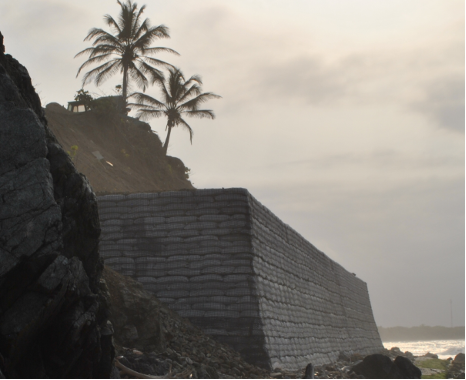
Service life refers to the period during which the structure can meet the service, stability, and safety requirements established in its design, under the anticipated conditions of exposure and maintenance. There is no single value applicable to all walls. Durability must be established during the design phase, taking into account the importance of the structure, environmental conditions, material properties, and the degradation mechanisms that may affect the reinforcing elements.
In geosynthetic-reinforced systems, one of the most important aspects is the ability to maintain the mechanical properties of the reinforcement throughout the design life. To achieve this, phenomena such as creep, degradation due to oxidation, exposure to chemical and biological agents, and mechanical damage associated with installation must be taken into account.
Factors Affecting Durability
| Factor | Impact on the structure |
| Filling Quality | Particle size, plasticity, moisture content, and mechanical properties influence the soil-reinforcement interaction and the magnitude of deformations. |
| Quality of Geosynthetics | The properties of strength, durability, creep, and damage resistance must be compatible with the project requirements. |
| Hydraulic conditions | Water infiltration and accumulation can lead to hydrostatic pressures, internal erosion, and a loss of bearing capacity. |
| Construction Procedures | The compaction, handling, overlaps, connections, and protection of the materials determine their subsequent performance. |
| External loads | Traffic, overloading, nearby buildings, and changes in use may alter the anticipated conditions. |
| Environmental Conditions | Temperature, UV radiation, and chemicals can contribute to the degradation of polymers and other components. |
It is important to distinguish between the design life and the actual service life. The former is a condition taken into account during the design phase; the latter depends on the design assumptions remaining reasonably valid and on any anomalies that may arise being addressed in a timely manner.
Regular Inspections: What to Check and When to Do It
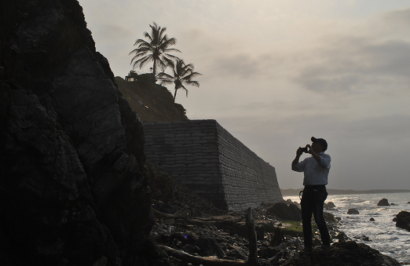
Maintenance should begin with an inspection program designed to identify changes in the wall’s geometry, hydraulic behavior, and surface conditions. Visual inspection is an initial diagnostic tool, but it must be supplemented with measurements, a review of historical data, and specialized studies when conditions that could compromise stability are identified.
Recommended inspection frequency
| Activity | Approximate frequency | Objective |
| General Visual Inspection | Semiannual or annual | Identify cracks, deformations, erosion, and visible damage. |
| Drain Inspection | Every six months and before periods of heavy rain | Check the continuity and proper operation of the drainage systems. |
| Special Inspection | After exceptional rainfall, flooding, earthquakes, or other events | Determine whether there have been any changes in stability or service conditions. |
| Detailed Evaluation | When anomalies are detected or as specified in the maintenance plan | Determine the cause, extent, and need for intervention. |
These intervals are for guidance only and do not replace the inspection plan established for each project. For high-rise structures, those with significant overloads, or those located in areas at risk of geotechnical hazards, it may be necessary to increase the frequency.
Items to Review
- Facade and exterior walls: Check for alignment, verticality, bulging, misalignment between elements, cracks, spalling, and localized damage. Changes from the original geometry are particularly significant.
- Wall crown: Identify differential settlement, longitudinal cracks, depressions, loss of slope, and water accumulation. Verify that there are no unanticipated overloads.
- Drainage system: Check water outlets, filters, drains, ditches, and catchment structures. Blockages, sediment, erosion, or uncontrolled runoff may indicate hydraulic problems.
- At the base of the wall: identify scouring, erosion, material loss, water accumulation, and changes in the ground that could affect the support conditions.
- Adjacent soil: Check nearby slopes, structures, utility networks, and traffic areas. External interventions may alter the load conditions or the behavior of the reinforced soil.
Signs of deterioration that require attention
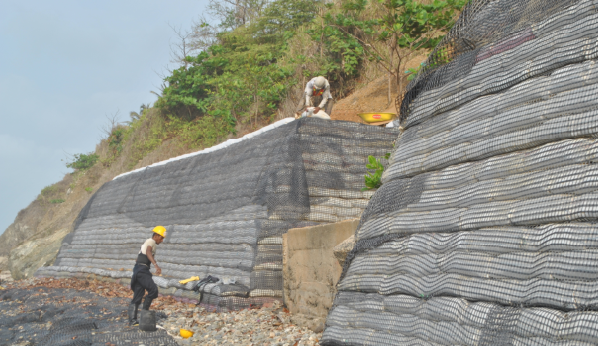
Visible damage does not necessarily indicate a structural failure. However, it may be a sign of processes that, if not identified in a timely manner, can progress and affect the structure’s performance. The interpretation must take into account the location, extent, progression, and relationship among the various signs.
Deformations and bulges on the facade
The appearance of bulges may be related to deformations in the fill, inadequate compaction, displacement of the reinforcement, unanticipated overloads, or changes in drainage conditions. A localized deformation should not be evaluated solely based on its appearance: it is necessary to determine whether it has stabilized or is continuing to evolve. To do this, survey control points or instrumentation systems may be installed, depending on the magnitude of the anomaly.
Cracks in the crown and the adjacent ground
Longitudinal or transverse cracks in the upper portion may be associated with differential settlement, movements of the reinforced mass, or instability processes involving the foundation soil. When these cracks grow, cause relative displacements, or are accompanied by deformations in the facade, a detailed geotechnical evaluation is required.
Seepage, Moisture, and Erosion
The presence of persistent moisture, unexpected water flow, or the transport of fine particles is a sign that warrants special attention. Under certain conditions, the flow can cause internal erosion, loss of backfill material, and a reduction in the system’s containment capacity. It is also important to check whether drainage outflows are causing erosion at the base of the wall or on nearby land.
Damage to facade elements
In walls constructed with precast panels, segmental blocks, or other cladding systems, it is important to identify displacements, cracks, joint openings, and missing fasteners. This damage may be superficial, but it may also indicate deformations in the reinforced core.
Preventive Maintenance Activities
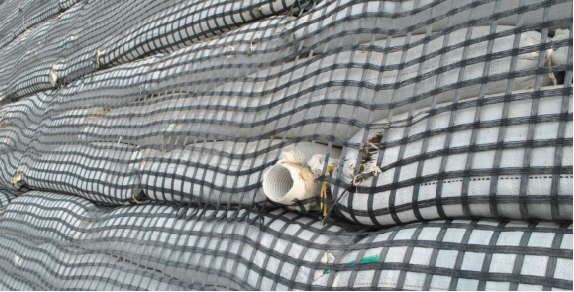
Preventive maintenance aims to preserve the wall’s operational condition and prevent initially minor issues from developing into more complex problems. In most cases, the most important activities involve water management, erosion control, and maintaining the structure’s geometry.
Drain Cleaning and Maintenance
Gutters, channels, downspouts, manholes, and drainage outlets must be kept free of obstructions. Cleaning must be performed without using tools or methods that could damage the geotextiles, pipes, or filter elements. It is also necessary to verify that the outlets direct water to safe locations and do not cause erosion of the underlying soil.
Surface Runoff Control
Water from the upper platforms and adjacent areas must be channeled through appropriate drainage systems. Water must not be allowed to flow freely over the top of the wall or to infiltrate the reinforced fill in concentrated areas.
Vegetation and Erosion Control
Vegetation cover can help control surface erosion, provided it is a solution compatible with the design. Species whose roots could damage facade elements, drains, or nearby facilities should be avoided.
Preservation of Geometry
Deformations must be documented through photographic records and periodic measurements. When survey control points are available, it is advisable to compare the readings with the initial values to identify trends.
Load Control and Modifications
No additional fill, structures, foundations, equipment, or loads should be added adjacent to the top of the wall without first verifying their compatibility with the design conditions. Similarly, excavations near the base or the back face of the wall may affect its stability and must be evaluated before they are carried out.
When should a wall in reinforced soil be repaired?
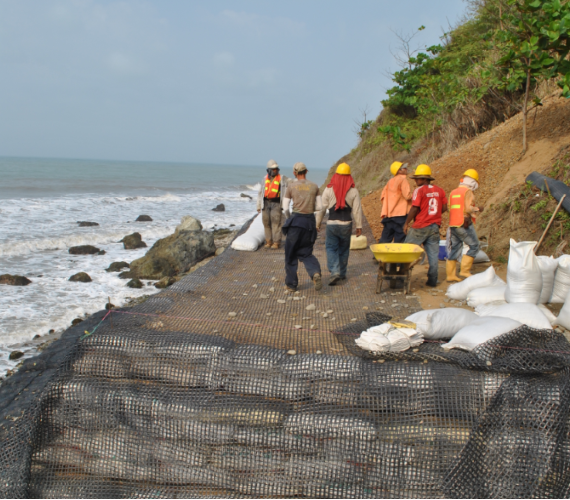
Not all anomalies require the same level of intervention. The decision must be based on the extent of the damage, its progression, the mechanism causing it, and the potential consequences for the structure's stability and functionality.
| Level of Care | Observed condition | Recommended Action |
| Preventive | Clogged ditches, uncontrolled vegetation, minor surface damage with no apparent progression. | Cleaning, maintenance, and condition logging. |
| Corrective | Localized leaks, surface erosion, damage to the facade, or minor deformations that require monitoring. | Identification of the cause, localized repair, and technical follow-up. |
| Specialized | Progressive cracks, significant bulging, differential settlement, or material displacement. | Geotechnical evaluation, instrumentation, and stability analysis. |
| Critic | Rapid movements, loss of support, significant undermining, or signs of overall instability. | Urgent assessment, access control, and security measures based on professional judgment. |
Mistakes That Can Shorten the Lifespan of a Wall
Some problems that arise during operation stem from decisions made during construction or from subsequent modifications. Among the mistakes that should be avoided are:
- Allow surface water to flow directly into the reinforced fill.
- Block or remove the outlets of the drainage system.
- Conducting excavations near the base of the wall without a prior assessment.
- Install utility networks that cause leaks within the massif.
- Incorporating overloads without verifying their effect on stability.
- Treat only the visible symptoms without investigating their cause.
- Using filler materials or repair procedures that are incompatible with the original specifications.
- Ignore deformities that progressively worsen over time.
The maintenance of a reinforced wall is not merely a matter of preserving its appearance. Its purpose is to preserve the geotechnical and structural conditions that allow the system to function as designed.
Reinforced soil walls are geotechnical solutions whose long-term behavior depends on the interaction between the soil, the reinforcement elements, the facing, and the drainage systems. Their service life should not be viewed as an isolated property of the materials, but rather as the result of proper design, controlled construction, and maintenance consistent with service conditions.