




Erosion control on slopes with TERRATRAC TRM blankets
Why do Terratrac blankets make a difference?
In infrastructure, mining and water projects, slope erosion control is not only an environmental requirement: it is a critical factor for the stability, durability and cost of the project.
However, achieving successful and sustainable revegetation remains one of the greatest technical challenges, especially in conditions of steep slopes, poor soils or intense rainfall events.
In accordance with the best practices defined by the ECTC (Erosion Control Technology Council), there are clear criteria for the selection of solutions, highlighting the role of permanent erosion control and vegetation reinforcement systems (TRM), where the Terratrac TRM blankets position themselves as a differential alternative.
1. The problem: erosion + failed revegetation.
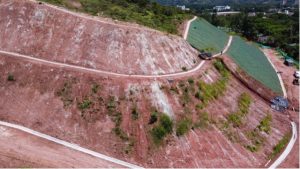
Exposed slopes face multiple erosion mechanisms, among which the following are highlighted:
- Laminar and furrow erosion due to surface runoff
- Detachment of fine particles prior to plant establishment
- Root system failure under hydraulically demanding conditions
The biggest problem occurs in the initial stage, when the soil remains vulnerable before the vegetation manages to consolidate.
Many temporary solutions, such as organic blankets or hydraulic treatments, fail precisely at this critical stage.
What does the ECTC say? Permanent vs. temporary solutions
Erosion control systems RECPs (Rolled Erosion Control Products) are classified as follows:
- Temporary erosion control berms
- Permanent erosion control blankets TRMs (Turf Reinforcement Mats)
TRMs are designed for:
- Provide immediate protection against erosion
- Mechanical reinforcement of vegetation
- Maintaining long-term performance under severe hydraulic conditions
The technical recommendation is clear:
In slopes with steep gradients, presence of concentrated flows or where permanent protection is required, the TRMs are the preferred solution.
3. Terratrac TRM: technical differential versus conventional solutions
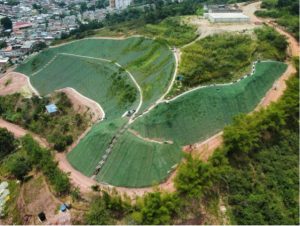
The mantles Terratrac TRM have been developed under this technical approach. According to their specifications, they offer:
- Three-dimensional porous matrix of synthetic polyester fibers
- High resistance to UV radiation (up to 90% retained resistance)
- Tensile strength (MD) up to 50 kN/m
- Controlled elongation close to 20%
- Inert material, no adverse effects on the environment
This configuration allows:
- Retain soil and seeds
- Facilitate root growth
- Integrate with mature vegetation
- Increase surface shear strength
This translates into a high capacity for:
- Withstand hydraulic stresses
- Maintain structural integrity over time
- Act as a permanent reinforcement of the soil-vegetation system.
- Respond better to conditions associated with climate change
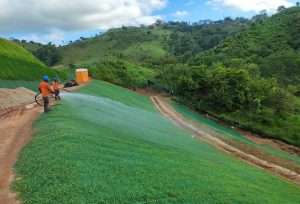
4. Conclusion: engineering for sustainable solutions
Effective erosion control should not rely solely on temporary solutions or depend on the uncertainty of plant establishment.
The evolution of engineering points towards permanent, reliable systems with predictable performance.
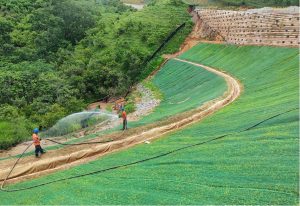
In this context, the Terratrac TRM blankets are consolidated as a superior solution, integrating into a single system:
- Immediate protection against erosive processes
- Structural reinforcement of the soil-vegetation system.
- Long-term hydraulic and mechanical performance
- High durability and stability against UV radiation