





Common mistakes in geotextile selection and how to avoid them
In many civil engineering projects, the geotextile selection plays a key role in guaranteeing performance in road works, drainage, soil stabilization and structure protection.
However, selecting geotextiles properly is not always as simple as it seems. Poor selection can lead to costly failures, loss of performance and reduction of project lifetime.
Below, we review some of the most common mistakes when selecting geotextiles and how to avoid them.
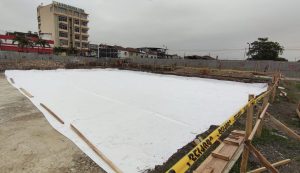
1. Choose the type of geotextile without analyzing the application
One of the most common mistakes is to select the geotextile based solely on price or availability, without considering its function within the project.
Geotextile is not the same as a geotextile for separation of layers in a pavement structure than one designed for booster.
For example:
- A woven geotextile can be ideal for reinforcement, separation and filtration.
- A nonwoven geotextile does not adequately satisfy the reinforcement function and is generally limited to applications where drainage is the primary function.
The key is to clearly define the function of the geotextile:
- separate
- filter
- drain
- reinforce
From there, the selection will be much more accurate.
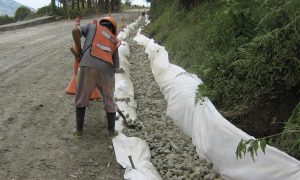
Ignoring soil properties
Another common mistake is not taking into account the characteristics of the soil where the geotextile is to be installed.
Granulometry, plasticity and fines content directly influence its performance.
A poorly chosen geotextile can:
- clogging or clogging
- affect drainage
- generate water accumulation and pore pressure
- allow the passage of fine particles
This compromises the hydraulic and structural performance of the system.
For this reason, a good soil study should be carried out and parameters such as the Apparent Aperture Size (AOS) helps to avoid such problems.
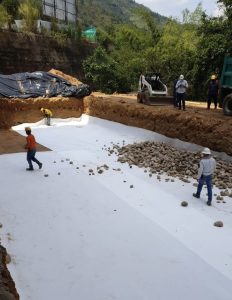
3. Failure to consider stress conditions
The level of stress to which the geotextile will be subjected is often overlooked.
This includes:
- static loads
- dynamic loads
- stresses during installation
Selecting a material with insufficient strength can cause:
- punch breaks
- tearing during installation
- deformations over time
Conversely, oversizing unnecessarily also implies unnecessary expense.
It is advisable to determine the context of the project and choose a geotextile that meets the minimum necessary requirements.
4. Neglecting installation conditions
Not everything depends on the material. The way it is installed also directly influences its performance.
A common mistake is not considering factors such as:
- sun exposure
- on-site handling
- site preparation
Geotextiles can degrade if they are exposed to UV radiation for a long time before being covered.
Also, their placement on uneven surfaces or with sharp elements can easily damage them.
Proper planning of the installation and training of personnel significantly reduces these risks.
It is also recommended to follow the construction specifications that establish the minimum requirements for survival criteria against typical installation damage.
5. Lack of technical advice
Relying solely on previous experience or general recommendations can lead to wrong decisions.
Each project has particular conditions that require a specific analysis.
Having specialized technical advice allows:
- validate the selection
- ensure compliance with standards
- optimize long-term costs
- improve system performance
This not only improves the technical result, but also reduces construction risks.
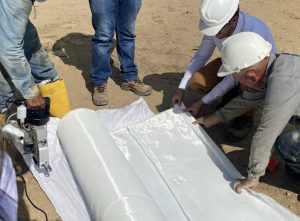
How to avoid these errors
Avoiding these problems is not complicated if some good practices are followed:
- Clearly define the function of the geotextile within the project.
- Analyze soil and loading conditions
- Carefully check its properties
- Verify compatibility with the application
- Do not underestimate the installation
- Seek specialized technical advice
Choosing the right geotextile can make the difference between a long-lasting project and one that requires constant repairs.
Taking the time to make a proper selection is not an additional expense, but an investment in the quality and safety of the work.