




DIFFERENCES/ADVANTAGES BETWEEN WOVEN AND NON-WOVEN GEOTEXTILES
Geotextiles are geosynthetic materials used in different areas of civil engineering such as pavements, geotechnics and hydraulics to provide specific functions in civil works such as reinforcement, separation, filtration, drainage, containment and erosion control. According to ASTM D4439, a geotextile is a permeable geosynthetic composed solely of textiles.
The properties of geotextiles are a function of their weave structure and the type of polymer from which they are made. In terms of weave structure, they are discriminated into woven and non-woven geotextiles. As for the type of polymer, they are commonly made of PET polyester, PP polypropylene, although there are also fiberglass geotextiles.
Woven geotextiles are parallel arrangements of orthogonally interwoven elements. Weaving is a process of interlacing elements that can be monofilament, flat tape or multifilament in a longitudinal arrangement called warp (MD or main direction along the roll) combined with a transverse arrangement of elements called weft (TD or transverse direction along the length of the roll). Within woven geotextiles there are different types of production, the flat woven geotextiles shown in Figure 1 (a) and the knitted geotextiles manufactured by weft insertion, as shown in Figure 1 (b).
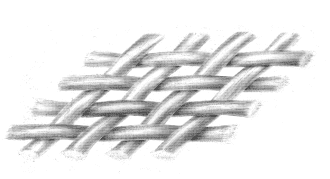
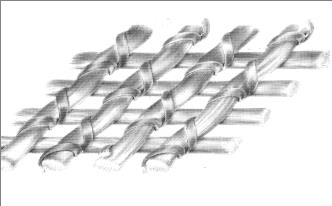
Figure 1. (a) Flat ribbon woven geotextile and (b) woven geotextile by weft insertion.
The geotextiles woven by weft insertion, present the horizontal and transversal fibers in two independent layers, which are intertwined by means of a third group of fibers that are inserted by adjusting the nodes, this allows them to be ready to assume load at the slightest deformation, maintaining their position and guaranteeing that the area of the pores or open area does not change by tensioning or confining the geotextile, achieving mechanical and hydraulic stability superior to the geotextiles woven of flat tape. Therefore, they are recommended for reinforcement, separation, filtration and drainage functions, while flat woven polypropylene geotextiles are discarded for filtration applications (see AASHTO M 288, numeral 8.2.2 requirements for geotextiles for subdrainage).
For example, geotextiles made of high tenacity polyester have a high tensile strength - deformation ratio (high mechanical modulus), i.e., they provide greater reinforcement at lower elongation, greater elastic recovery capacity and stability in the long term than geotextiles made of polypropylene.
Nonwoven geotextiles are manufactured from staple fibers or continuous filaments randomly distributed in layers on a moving belt to form a «fabric». These fibers can be bonded together mechanically by needle punching or thermally or chemically (see Figure 2). The main applications for nonwoven geotextiles are subsurface drainage and separation.
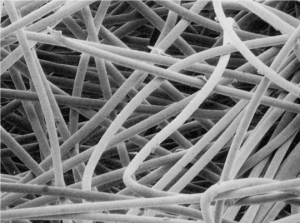
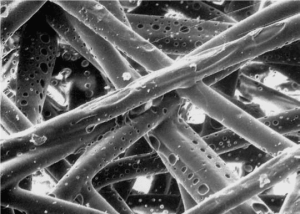
Figure 2. Nonwoven geotextiles (a) mechanically bonded and (b) thermally or chemically bonded.
Finally, we recommend the following functions for the different geotextiles we handle:
| Geotextile | Manufacturing | Polimero | Function |
| FORTEX BX | Weft insertion weaving | High Tenacity Polyester |
|
| HYDROTEX | Flat weave |
|
|
| PROPYWEAVE | Plan ribbon weaving | Polypropylene |
|
| FIBER-TEX | Non Woven |
|