





Effect of Creep on the Design and Construction of Soil Walls Reinforced with Geogrids and Geotextiles
Creep, or creep, is a phenomenon that occurs in construction materials subjected to constant loads over long periods of time, resulting in deformations that can affect the structural integrity of buildings. In the field of civil engineering, the effect of creep in soil walls reinforced with geogrids and geotextiles is especially relevant and, in particular, is a fundamental aspect in the design and construction of these structures.
Reinforced soil walls are structures that use geogrids and geotextiles to improve the stability and strength of the soil, being subjected to constant loads throughout the service life. These materials can experience creep under the influence of such loads, which can lead to a gradual increase in deformations and, ultimately, to structural failure. The effect of creep in soil walls reinforced with geogrids and geotextiles is a critical factor that must be carefully considered in the design of these structures.
Creep in detail is the deformation of a material under constant application of tensile stress. Unlike elastic behavior, deformation does not occur suddenly under the application of stress or strain, but is the result of sustained stress over time. The stages of creep deformation are shown in Figure 1. Here “ε0” is the instantaneous deformation associated with the application of the initial stress. This is followed by primary creep deformation, which is essentially work hardening as the material adjusts to the applied stress. Secondary or steady-state creep is the most important and is the focus of most creep studies. Finally, tertiary creep increases exponentially with stress, usually due to specimen narrowing, and eventually leads to creep failure.
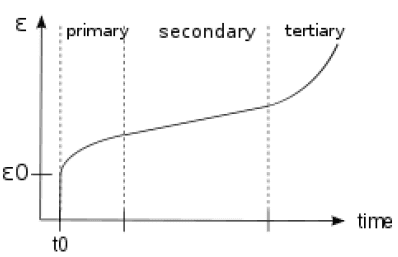
Figure 1. Creep deformation states
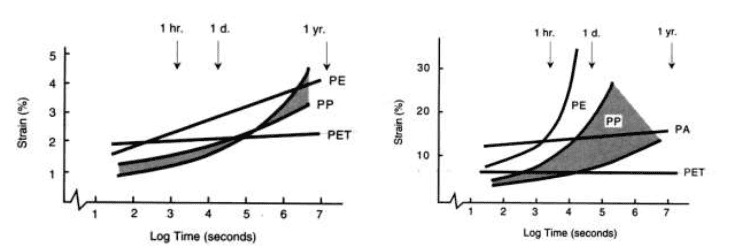
The geogrids and geotextiles, As polymeric materials, they follow these same generalized trends. The creep on geosynthetics for reinforced soil walls is a function of the polymer used, the production process, the service temperature and the applied load levels. Figure 2 shows data illustrating the secondary and tertiary creep behavior at high and low stress levels for different polymers used in geosynthetics.
 |
|
| TO) Creep to 20% of ultimate voltage | B) Creep to the ultimate voltage 60% |
| Figure 2 - Generalized creep response of various types of polymers (den Hoedt, 1976). | |
To control this situation, a reduction factor must be applied that limits the stress or strain applied to the geosynthetics to control the level of deformations, thus guaranteeing the safety of the structure.
In the context of the geogrids In order of magnitude for the reduction factor by creep for each type of polymer commonly used, we have an order of magnitude for the reduction factor by creep for each type of polymer commonly used as follows:
| Geogrids HDPE integral | 2.60 to 2.70 |
| Geogrids Woven or knitted PET | 1.40 to 1.58 |
| Geogrids of PET bars or strips | 1.40 to 1.45 |
Taken from GSI White paper #29 Creep Strain Testing of Geosynthetics*
The above values are used for the calculation of the available resistance. Tallow according to Koerner 2012, applying the following equation.

Where
TLTDS = long-term design strength
Tult = strength of the product as manufactured https://www.google.com
RFC.R. = creep reduction factor
RFID = reduction factor for change of installation
RFED = environmental degradation reduction factor
Finally, it is indicated that a lower value of the creep reduction factor represents a more stable and efficient polymer for soil reinforcement in the construction of retaining walls in reinforced soil, high slope slopes and foundations on soft soils.
Through proper material selection and careful design considerations, the impact of creep is controlled and the long-term stability and durability of these structures is ensured.