





Biaxial Geogrids in Pavements
How do biaxial geogrids work in granular layers of a pavement?
Biaxial geogrids in granular layers of a pavement are a key solution to improve the structural performance of roads. In the world of pavements, there are solutions that go unnoticed by those who are not on site, but that make a huge difference in pavement performance. Biaxial geogrids are one of them (see Figure 1).
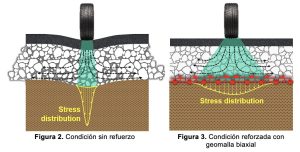
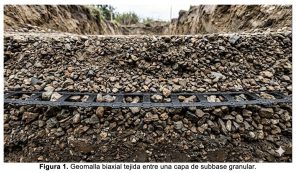 They perform the function of distributing traffic loads to the natural soil. However, when the material does not have sufficient stiffness or the supporting soil is weak, deformations appear: rutting, differential settlement and loss of structural capacity. This occurs mainly due to the lateral displacement of the aggregates under cyclic loading and the lack of effective confinement within the layer, as shown in Figures 2 and 3.
Performance of biaxial geogrids in granular pavement layers
They are polymeric structures with regular openings as shown in Figure 4, designed to work in two main directions. Their function is not “load bearing” as such, but to interact with the granular material.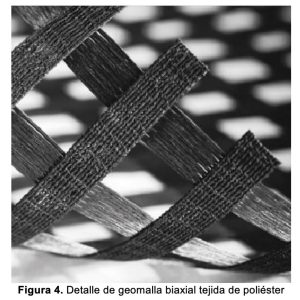
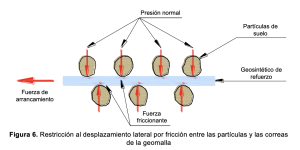
The interaction is caused by the confinement of the geogrid between granular layers, which results in the occurrence of two key phenomena: the entrapment of soil particles in the geogrid openings and the friction that develops on its ribs or belts.
Clogging occurs when aggregates penetrate the openings of the geogrid, generating a kind of “anchorage” that limits the lateral movement of the particles.
The biaxial geogrids in granular layers of a pavement reduce the lateral displacement of the material.
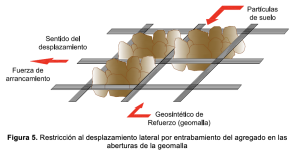
This interaction causes the tensile strength of the geogrid to be transferred in both directions to the soil mass, increasing its shear strength and consequently stiffening the layer.
In woven geogrids, an additional contribution is achieved by friction transfer between granular material and the geogrid ribs, given the width of the ribs, as shown in Figure 6.
Advantages of using biaxial geogrids
The use of biaxial geogrids in a pavement structure brings concrete advantages such as:
- Reduction of the required thickness in unbound granular layers.
- Longer service life.
- Lower maintenance associated with lower deformations.
- Improved performance of the structure on soft soils.
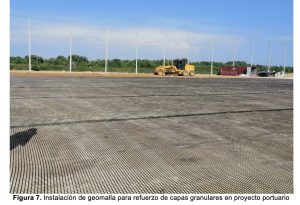
In many projects, this translates into savings in materials, reduction of transportation costs and mitigation of negative environmental impact, especially in areas where good quality aggregate is scarce. A clear example of the use of this type of geogrid can be seen in the photograph below, which shows the installation of a woven polyester biaxial geogrid to reinforce and stiffen a granular layer in a port project.
In summary, the incorporation of biaxial geogrids in granular layers constitutes an efficient mechanical improvement strategy.
This is based on soil-reinforcement interaction. Through the mechanism of interlocking and friction, the composite stiffness of the system is increased and the distribution of stresses induced by repeated loads is optimized. This effect translates into a reduction of permanent deformations, a better control of rutting and a greater structural stability of the system. pavement which not only improves long-term performance, but also enables more technically, economically and environmentally efficient designs.