





Quality of backfill in MSE walls and its structural impact
In mechanically stabilized soil walls (MSE), the forming soil is one of the most decisive elements for the overall behavior of the structure. The quality of backfill in MSE walls directly influences soil-reinforcement interaction, stress distribution and long-term stability.
Although attention is often focused on the geometric design or reinforcement systems, the actual performance of the wall depends to a large extent on the material strictly complying with the technical specifications from the design stage. Inadequate backfill can generate progressive deformations and compromise the stability of the entire structure.
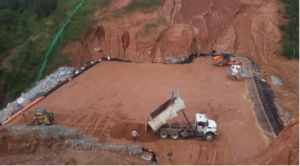
Illustration 1. Embankment reinforced with geosynthetics
Control of particle size in MSE walls
One of the first aspects that must be checked in the quality of backfill in MSE walls is the particle size.
Particle size distribution has a direct influence on:
- drainage capacity
- mechanical behavior
- ease of compaction
For this type of structure, granular materials are preferred, with a predominance of sands and gravels, which allow for rapid dissipation of water pressures.
When the material contains excess fines, especially clays:
- decreases permeability
- increases moisture retention
- the risk of deformation is increased
💡 TIP
Geotextiles can function as a separating layer to prevent contamination of the structural fill with soft soils.
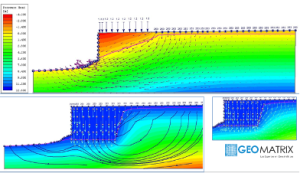
Effect of drainage on MSR. a) Concentration of pressures in material with excess of plastic fines. b) Concentration of pressures in granular material. c) Concentration of pressures in material with excess of plastic fines. d) Concentration of pressures in granular material.
Plasticity limits and their impact on MSE walls
The control of plasticity limits makes it possible to identify the presence of active fines within the filler.
A soil with a high plastic index:
- is sensitive to humidity changes
- can expand or contract
- reduces internal friction
- decreases the efficiency of reinforcement anchorage
In MSE walls, this directly affects the soil-reinforcement interaction and can generate problems such as:
- loss of resilience
- desiccation cracking
- water ingress from the crest
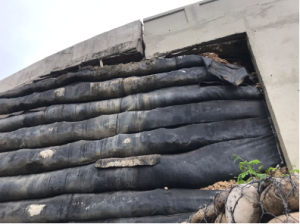
Deformations in MSR facades.
Importance of compaction in MSE walls
Compaction is a critical aspect in the production quality of backfill in MSE walls.
It is not enough to select good material; it is necessary:
- layer in controlled layers
- achieve specified densities
- maintain uniformity throughout the structure
Poor compaction results in:
- internal voids
- lower rigidity
- major deformations
While proper compaction:
- improves shear strength
- optimizes structural performance
- reduces displacements on the facade
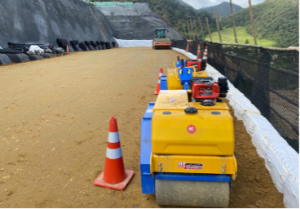
Layer compaction for an MSR.
💡 TIP
Installing the reinforcement without bending or slack, ensuring alignment and tension, is key to system performance.
Consequences of poor backfill quality in MSE walls
Problems resulting from poor control can occur during or after construction.
Among the most common:
- horizontal displacements
- bulges in the facade
- settlements in coronation
- loss of alignment
In severe cases:
- internal failures due to loss of adhesion
- increased lateral thrust
- partial collapses
These problems usually occur when the wall is in service or in the presence of water.
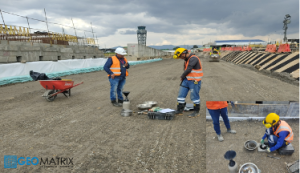
Compaction control on site, MSR.
Conclusion
The control of the quality of backfill in MSE walls should not be considered a documentary requirement, but a fundamental measure to ensure structural stability.
Essays such as:
- granulometry
- Atterberg limits
- field density
allow to validate that the material complies with the design.
Rigorous supervision from supply to final installation reduces pathologies and prolongs the useful life of the wall, especially in road works and structures subjected to variable loads.