

5 Keys to Hydrotube Filling and Sludge Dewatering
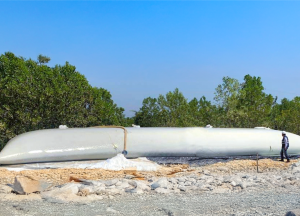
Geotextile tubes Hydrotube are an efficient solution for the erosion control, hydraulic protection and sludge dewatering in infrastructure and mining projects.
Its performance depends directly on a correct process of installation and fillingThis guarantees the stability of the structure and the retention of solids.
Below, we share with you 5 key tips for successful filling of Hydrotubes:
1. Prepare the support surface
Hydrotube performance begins with a firm, level foundation.
The surface must be free of roots, stones or sharp elements that could damage the geotextile.
In hydraulic structuresIn order to prevent the installation of an anti-socavation blanket, it is essential to install a properly tensioned anti-socavation blanket, with industrial stitching or overlapping, and with ballasts to prevent displacements.
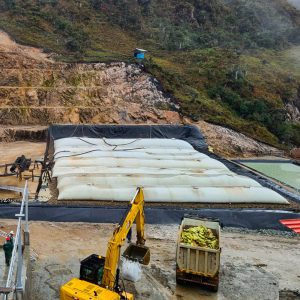
In dehydration applicationsIn addition, a confinement system with geomembrane and protective geotextile is recommended, together with a granular drainage bed to collect and convey the effluent water.
➡️ BenefitThis preparation reduces the risk of differential settlements and guarantees uniformity in the load.
2. Control the quality of the filling material
The structural and functional success of the Hydrotube depends on the quality of the material:
-
For hydraulic control2 mm sand with low fines content (max. 15% passing sieve No. 200) is recommended.
-
In mining and slurry dewateringTailings should be conditioned with flocculants or polymers to improve particle agglomeration and filtration efficiency.
Prior to installation, the following must be performed particle size tests and filtration tests to adjust the system design.
3. Proper handling of filling ports
Filling should be progressive, alternating the opening and closing of the ports. This allows a uniform sedimentation of the material inside the Hydrotube and avoids localized accumulations.
During the process, at least one port must remain open to allow controlled release of excess water, which ensures internal consolidation and avoids overpressure that could compromise the geotextile.
➡️ Benefithomogeneous distribution of solids to ensure structural stability.
4. Regulating flow rates and pumping pressures.
Pumping must be carried out under strict hydraulic parameters:
-
Maximum port pressure: 5 psi (35 kPa).
-
Discharge pipe diameter: between 6" y 10".
-
Use of gate valves to precisely control flow rates.
With this control, the design height is achieved without inducing excessive stresses that could damage the system.
5. Protection and coating of Hydrotubes
After filling, the ports must be closed with geocable mooring systems and inserted inside the pipe to prevent leaks.
To ensure long-term durability, it is recommended that Hydrotubes be coated with:
-
Screeds, cover soils or erosion control blankets (example: Terratrac TRM 50).
-
Concrete coatings (articulated mattresses) or confined rockfill mattresses with Geoestera hydromesh.
Conclusion
Following these 5 tips ensures an efficient and long-lasting filling process, optimizing the performance of the filling process. Hydrotubes in hydraulic, mining, sludge and tailings dewatering projects.
At Geomatrix, we have installation guides and specialized technical advice to guarantee the success of your project.