





The importance of drainage and underdrainage in reinforced soils
In a structure of reinforced floorIn addition, proper water management reduces the risk of saturation, minimizes hydrostatic pressure and prevents problems such as erosion or even structural collapse.
According to the Federal Highway Administration (FHWA)In addition, well-designed drainage systems are indispensable for the success of any infrastructure project with reinforced soils (e.g., a drainage system).FHWA guidelines).
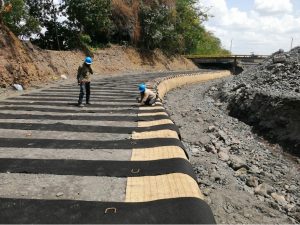
Importance of drainage in reinforced soil walls
Water is the most critical factor in slope and wall stability. Its infiltration can cause:
-
Increased pore pressures, reducing the effective soil resistance.
-
Generation of hydrostatic pressures behind the wall, increasing the lateral load.
-
Fines entrainment and internal erosion (piping), which compromise the soil-reinforcement interaction.
👉 The objective of the sewer system is to control, collect and evacuate infiltration water so that it does not act negatively on the system.
Drainage methods in reinforced soil walls
Vertical gravel drains
Columns of permeable granular material placed behind the facing or in the backfill. They facilitate vertical flow and reduce pore pressure.
Geodrenes
Draining geocomposites that combine a geonet or geonet with filtering geotextiles, conducting water efficiently.
Perforated drainage pipe (sub drains)
Installed at the base of the wall or within the reinforced soil mass. They are surrounded by gravel and filtering geotextile to avoid clogging, capturing and evacuating water to a discharge point.
Granular filters and geotextiles
Located behind the facing. They allow the passage of water without dragging fines, guaranteeing stability in the soil-reinforcement interaction.
Surface drainage
It includes ditches, gutters, crown ditches and liners to prevent direct infiltration of rainwater. Even a wall with internal drainage can fail if water accumulates at its crest.
Design and construction recommendations
-
Integrate drainage and reinforcement from the design stage.
-
Use well-drained granular materials in the backfill.
-
Maintain the continuity of the drainage system.
-
Ensure on-site quality control to avoid voids or internal erosion.
-
Post-construction monitoring with piezometers and inspection drains.
A practical resource on geosynthetics and their use in drainage can be found at IGS - International Geosynthetics Society.
FHWA regulations on drainage and underdrainage
The FHWA establishes clear guidelines in its document Mechanically Stabilized Earth Walls and Reinforced Soil Slopes Design and Construction Guidelines:
-
Redundant drainage systems in high rainfall areas.
-
Technical specifications for the flow capacity of drains.
- Compliance with these guidelines helps to mitigate risks, optimize structural performance and guarantee the durability of reinforced soil walls.
✅ With this approach, drainage and underdrainage are not an accessory, but a component. vital to the safety and longevity of civil engineering works.