





Reinforced-soil walls in seismic zones
The Reinforced Earth Walls (MSR) have proven to be a highly efficient solution for slope stabilization and earth retention. In areas of high seismic risk, their performance takes on particular significance due to their flexible nature, which contrasts with the rigidity of traditional concrete systems. This ability to deform in a controlled manner allows them to dissipate seismic energy and redistribute stresses, reducing the likelihood of sudden failure; however, it also requires a more comprehensive design approach, in which allowable deformations are just as important as ultimate strength.
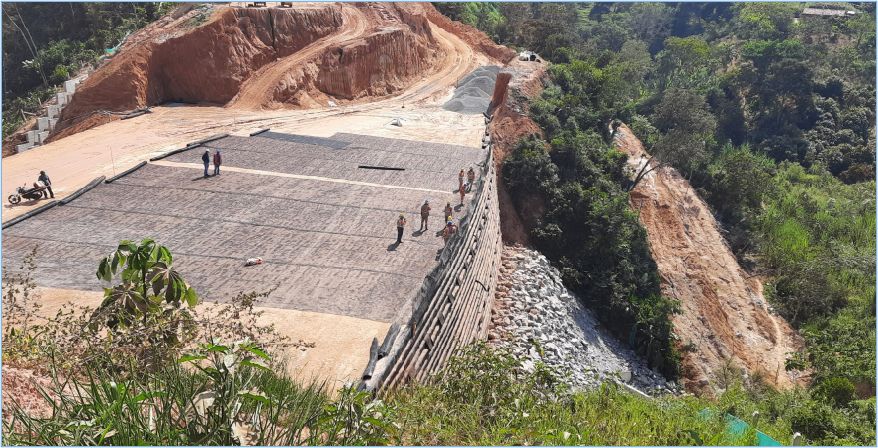
Figure 1. Reinforced earth wall (MSR) built along the Vías del Nus.
How are seismic loads on a wall in reinforced soil analyzed?
Pseudo-static method and Mononobe-Okabe theory
The analysis of seismic loads on walls in reinforced soil is commonly addressed using pseudo-static methods, in which the effect of the earthquake is represented as equivalent inertial forces proportional to the weight of the reinforced mass (see Figure 2). These forces alter the stress state within the soil and generate an increase in lateral thrusts on the structure.
To estimate these forces, the Mononobe-Okabe theory, which extends classical limit-state models by incorporating seismic accelerations. This approach makes it possible to account for the increase in active forces, as well as the change in their point of application and direction—factors that directly affect external stability, particularly with regard to sliding and overturning.

Figure 2. Representation of the horizontal loads considered in the seismic design of a wall on reinforced soil.
Design of Geosynthetic Reinforcements Under Seismic Conditions
Anchorage Length of Reinforcing Bars
From a reinforcement standpoint, seismic design involves significant adjustments compared to static conditions. The length of the geosynthetic reinforcement elements is increased in order to improve anchorage capacity (see Figure 3) and ensure adequate load transfer to the passive zone. This increase addresses the need to compensate for potential losses in confinement and the temporary degradation of strength during a seismic event.
Vertical Spacing and Deformation Control
Likewise, reducing the vertical spacing of the reinforcements contributes to better control of deformations and greater overall stiffness of the reinforced mass, which is key to limiting excessive displacements on the wall face. Another aspect to consider is the soil-geosynthetic interaction with the backfill soil and at the level of the wall’s foundation.
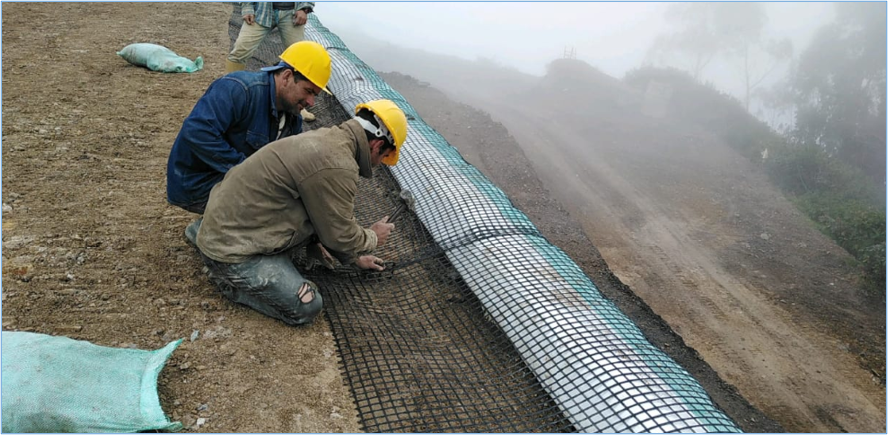
Figure 3. Construction process for anchoring geogrids to the facade of a reinforced soil wall.
Tensile Strength and Shear Strength of Reinforcements
Tensile Strength Test
Verifying the tensile strength of reinforcements is particularly important under seismic conditions, as stresses can increase significantly due to dynamic loads. In this context, it is necessary to consider reduction factors associated with durability, installation, and long-term behavior, but also to evaluate the response under short-duration transient loads.
Analysis of Pullout Resistance
Similarly, the analysis of pullout resistance must incorporate more stringent conditions, since seismic motion can alter the soil confinement conditions and reduce the effective mobilizable friction.
Overall Stability of Walls on Reinforced Soil
With regard to the overall stability of the system (see Figure 4), reinforced earth walls in seismic zones require a rigorous evaluation that takes into account both internal and external stability. Analysis using limit-state methods remains standard practice, but for more critical projects, it is advisable to supplement this with dynamic analysis or displacement-based methods, such as the Newmark approach. These methods allow for the estimation of cumulative permanent deformations during an earthquake, providing a more realistic view of the structure’s expected performance.

Figure 4. Global stability analysis of a wall on reinforced soil.
External stability and foundation soil conditions
A key aspect that should not be underestimated is the interaction between the wall and the foundation soil conditions. In seismic zones, the bearing capacity can be affected by a decrease in soil stiffness or phenomena such as liquefaction. Therefore, it is essential to conduct a detailed geotechnical characterization and, if necessary, implement ground improvement measures or drainage systems to mitigate the build-up of pore pressures. Drainage, in particular, plays a critical role in both static and post-earthquake conditions, as the accumulation of water can significantly reduce the soil’s shear strength.

Figure 5. External stability analysis of a wall on reinforced soil.
The Importance of Construction in Seismic Performance
In practice, the satisfactory performance of a wall on reinforced soil depends not only on proper design but also on the quality of construction. The proper selection and placement of backfill material, compaction control, and the proper installation of reinforcements are key factors in ensuring that design assumptions are met in the field. In seismic zones, these aspects take on even greater importance, as any construction deficiency can be amplified during a seismic event.
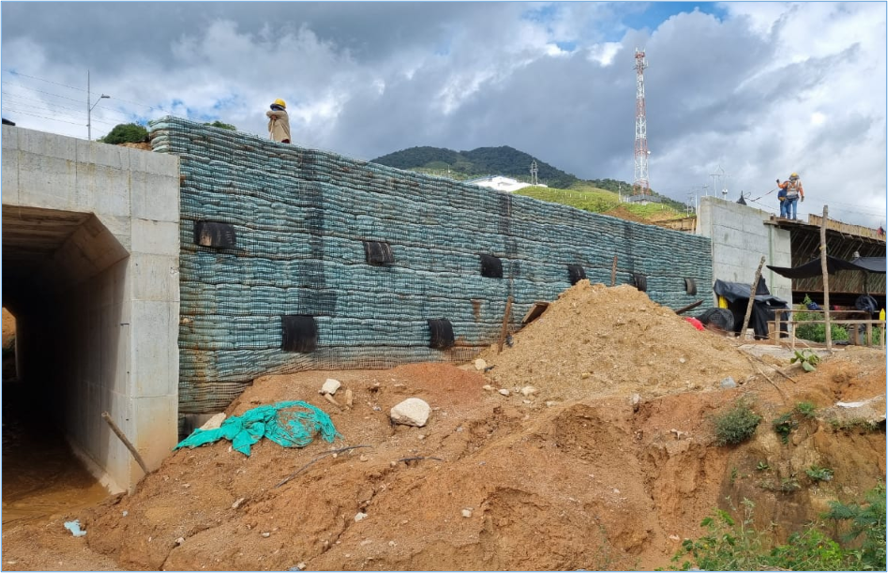
Figure 6. Reinforced earth wall constructed between more rigid structures.
Conclusion
Finally, it is important to understand that the design of reinforced-soil walls in seismic zones must focus on the structure’s performance, in which certain deformations are acceptable as long as they do not compromise the structure’s functionality or safety.
This philosophy is particularly well-suited to linear infrastructure such as roads, where minor deformations may be tolerable. In this regard, engineers must strike a balance between cost-effectiveness, safety, and functionality, drawing on current standards such as the FHWA and AASHTO guidelines in combination with local regulations, and adapting these criteria to the specific conditions of the project.