





Soil quality and its impact on reinforced soil walls
Typically, reinforced soil walls are flexible retaining structures that combine soil layers with geosynthetic reinforcements to improve their strength and stability. Their performance depends largely on the materials used for both forming and reinforcement material.
Based on the recommendations of the manuals FHWA-NHI-10-024 (Design and Construction of Mechanically Stabilized Earth Walls and Reinforced Soil Slopes) and FHWA-NHI-00-043 (Mechanically Stabilized Earth Walls and Reinforced Soil Slopes - Design & Construction Guidelines), we will discuss how the properties of the forming soil influence the performance of the reinforced soil wall and what are its selection criteria.
CONFORMATION SOIL
Much of the knowledge and experience of the engineering communities with reinforced soil wall structures has been based on selected cohesionless granular soils.
According to the FHWA, not all materials are suitable for this type of structures, as they require specific characteristics of granulometry and plasticity among others. In particular, the FHWA recommends using granular soils with a maximum particle size no larger than 75 mm (3 inches) to reduce damage to geosynthetics during compaction. In addition, the content of material passing the #200 sieve should be less than 15% to ensure good drainage and prevent the buildup of hydrostatic pressures. The use of reclaimed or recycled asphalt or concrete materials is not recommended. Recycled asphalt is prone to creep due to temperature changes and concrete, due to the presence of non-hydrated free cement particles, can cause drainage problems.
For structures with a commitment to deformation control, soils with a coarse grain size and good gradation (classified as GW or SW in the Unified Soil Classification System) are the most suitable because of their high permeability and shear strength and should be compacted to at least 95% of their maximum dry density. On the contrary, soils with high clay or plastic silt content, which can generate swelling and loss of strength problems with moisture changes, are considered marginal and their use is limited to structures where deformation control is not a variable to be observed.
Plasticity Index is a critical parameter in the selection of backfill soil. The FHWA recommends soils with a PI ≤ 6%, as they are less susceptible to volumetric changes. If the PI exceeds 10%, the soil is considered unsuitable due to its expansive potential and low permeability.
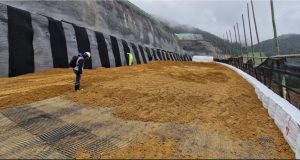
Photograph 1. Formation of wall with selected material.
MARGINAL SOILS
Using backfill materials outside the gradation and plasticity requirements is possible in some cases. However, problems of excessive deformation of the facade and structural failure due to low drainage capacity may occur. According to research conducted by the NCHRP (National Cooperative Highway Research Program), soils with up to 35% of material content passing the No. 200 sieve could be safely implemented, provided that the material properties are well defined and controls are established to address potential problems of drainage, deformation and construction processes, among others. Implementing a material with these characteristics could mean great savings in the project budget, but the effect on the long-term performance of the structure should be evaluated.
For reinforced soil walls using a backfill with more than 15% of material passing the No.200 sieve or a plasticity index (PI) greater than 6, it is essential to analyze in detail the shear strength parameters, both total and effective. This study allows an accurate evaluation of critical aspects such as horizontal stresses, the risk of sliding, the possibility of composite failure (affecting both the zone behind and through the reinforcement) and the impact of drainage on the structural behavior.
In addition, pullout tests of the reinforcement under short- and long-term conditions are required, together with friction tests at the soil-reinforcement interface. Special attention should also be paid to the settlement characteristics, particularly with regard to the stresses transmitted to the facade connections and the possible subsidence of adjacent structures.
The design should include a thorough evaluation of the drainage and underdrainage systems, both at the back and at the face and base of the reinforced area. Techniques such as flow network analysis are useful to determine the effect of seepage forces and hydrostatic pressures. In cases where these materials are used outside of the FHWA recommendations, it is recommended to provide the wall surface with a positive slope that favors the drainage of water away from the structure. For all types of reinforced soil walls where the crown will be exposed to the elements, it is recommended to implement an impermeable layer at the crown of the wall to prevent water infiltration into the forming material. In addition, the top two layers of reinforcement should extend beyond the defined reinforcement length in order to avoid the appearance of stress cracks directly behind the reinforced zone.

Photograph 2. Deformations in MSRs when marginal backfill and poor underdrainage are used.
CONCLUSION
In conclusion, to follow the guidelines recommended by the FHWA in the selection of materials for reinforced soil walls, in complement with Geomatrix geosynthetics, allows guaranteeing the stability, durability and safety of these structures. The specifications on granulometry, plasticity, drainage and compatibility with geosynthetics are not arbitrary; they respond to decades of research and experience in the observation of their behavior. An inadequate backfill or the modification of the type of geosynthetics, especially the change from geogrids to geotextiles, without a design adjustment, can lead to sliding failures, differential settlements or premature degradation of the reinforcements, compromising the integrity of the wall and the surrounding structures.