




Flexible linings for channels
In the hydraulic design of canals, one of the most important decisions is the selection of the flexible coating that will ensure the stability and durability of the structure against the flow of water. Among the available options, the flexible coatings (such as waterproof textiles, erosion control blankets, confined rockfill, textile formwork filled with fine aggregate concrete) stand out for their adaptability and cost-effectiveness. But how do you know which one is right for your project? The key is in the shear stress.
What is shear stress in a channel?
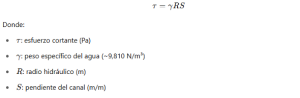
The shear stress (τ) is the force per unit area exerted by the flow of water on the channel bed and slopes. This parameter indicates the flow drag capacity and helps us to know if the coating will be able to resist without erosion.
It is generally calculated with the following simplified formula for uniform flow:
Why use flexible coatings?
Flexible coatings for canals are better adapted to land deformations, require less land preparation, allow some degree of infiltration and some allow the establishment of vegetation, which is desirable in some cases.
Some examples:
- Waterproof Textile - Impertex
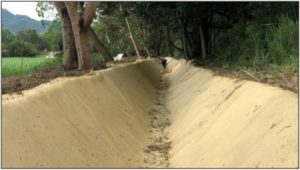
- Erosion Control Mantles (TRM) - TRM 50 Mantle
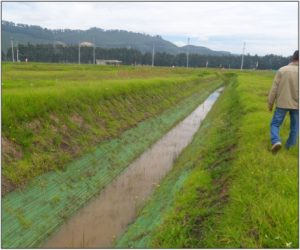
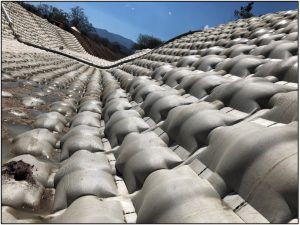
- Textile formwork filled with fine aggregate concrete - Articulated Mattresses
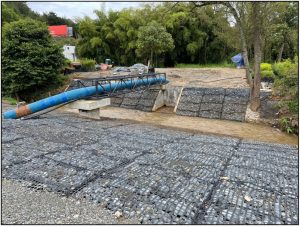
- Confined rockfill mattress with Geoestera hydromesh
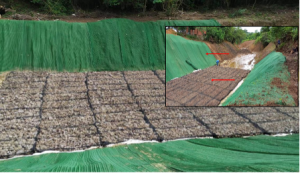
- Combined solutions - Manto TRO 50 e Hydromesh Geoestera
Selection based on shear stress: how much can the material resist?
Each type of coating has a critical shear stress (τc), which is the maximum value it can withstand without starting to deteriorate. For example, according to FHWA, HEC 15, the following limit values are given:
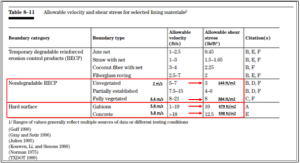
The rule is simple:
What about curved sections?
The curved sections of the channels present an additional challenge: the flow tends to be concentrated at the exterior wallThe shear stress in that area is increased.
A commonly used formula to adjust the shear stress in curves is:
Where K can vary between 1.5 and 2.5 depending on the radius of curvature, channel width and slope. This value is generally determined by tables or empirical studies (such as those of the US Army Corps of Engineers o FHWA).
Step-by-step process for selecting the coating
- Calculate the shear stress τ in straight and curved sections.
- Identify the highest value obtained (the most critical).
- Consult material resistance tables (τc).
- Select a coating with τc ≥ τ.
- Verify compatibility with other site conditions (ecological, constructive, maintenance, cost).