

FORTEX geotextile reinforcement mechanism
GEOMATRIX FORTEX high modulus woven geotextiles, made with High Tenacity Polyester (PET) G5 Multifilament fibers, offer high mechanical and hydraulic performance. Its structure with weft insertion allows fast response in tension to soils with low bearing capacity and hydraulic stability in any condition. Ideal for reinforcement with FORTEX geotextiles.
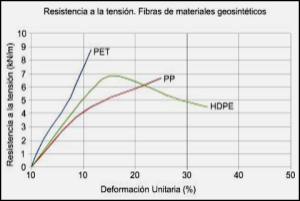
- Present a high tensile strength - deformation ratio (high mechanical modulus, see Figure 1). The aforementioned high modulus establishes a tensile component that when involved in the granular medium increases the elastic recovery capacity, increases the bearing capacity of the granular substructure and avoids deformation of the foundation soil, thus favoring both the construction process and the functional competence of the pavement.
-
- Figure 1. High Modulus of Deformation of polyester geotextiles.
-
- (From Typical properties of fibers. Batson. Designing with Geosynthetics. RM Koerner).
- PET: high tenacity polyester, PP: polypropylene, HDPE: high density polyethylene.
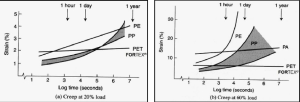
High mechanical stability over time (low creep, see Figure 2). This concept refers to the low yielding or long-term deformation compared to polypropylene (PP) geotextiles, which means that the reduction in resistance due to this concept is minimal and, therefore, the reinforcement function is maintained over time, controlling future deformations of the structure.
-
- Creep results on fibers of different polymers.
Koerner R.M, Designing with Geosynthetics They guarantee durability in contact with naturally aggressive soils, thanks to their chemical characteristics associated with the high molecular weight and carboxyl group of PET Multifilament G5.
- They show stability in their hydraulic behavior in any state of tension or confinement. Geotextiles FORTEX are manufactured using the weft insertion weaving technique, in which the horizontal and transverse fibers are arranged in two independent layers, interlaced with a third group of fibers that are inserted by adjusting the nodes, as shown in the following figure. Figure 3. In this way, the main fibers remain straight, ready to assume load at the slightest deformation, while maintaining their position, guaranteeing that the pore area or open area does not change due to tension or confinement of the geotextile. Complementarily, the multifilament fibers offer capillarity, achieving a subdrainage effect within the geotextile plane.
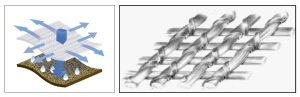
Figure 3. Weft insertion fabric.
geotextiles FORTEX by interacting between the granular layers or between the subgrade soil and the granular layers, generate a stiffening effect that increases the bearing capacity of the soil while modifying the distribution of stresses at depth. The above effect is explained by the phenomena illustrated below
- Improved support capacity.
- Stressed membrane effect (Perkins and Ishmeik1997a).
Improved support capacity
This mechanism is a consequence of the upward displacement of the failure envelope of the foundation system. The geotextile acts as a barrier that controls the lower surface of the failure envelope, confining it completely to the upper soil layer that offers higher shear strength than the subgrade (see Figure 4).
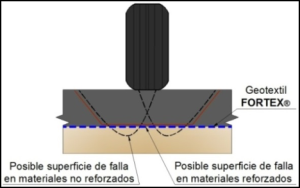
Figure 4. Effect of improved bearing capacity.
Tensed membrane effect
This effect is based on the improvement of the vertical stress distribution capacity resulting from the tensile stress in a deformed membrane (see Figure 5). The deformation of the subgrade soil upon the application of the load causes the tensioning of the geotextile, whose vertical component generates a relief of the stresses imposed by the overload, thus protecting the foundation soil.
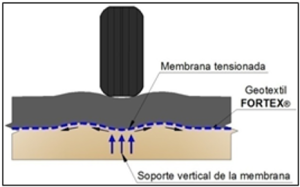
Figure 5. Tensioned membrane effect.
As a complement to the above, when in direct contact with the subgrade, it acts as a means of separation between the subgrade material and the granular layers, avoiding contamination by intrusion and/or direct contact, guaranteeing the performance of each layer of material from the beginning (see Figure 6).
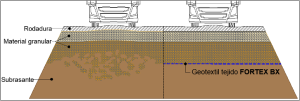
Figure 6. Geotextile FORTEX separating layers of material.
As can be seen, by placing the FORTEX high modulus geotextile, a triple benefit of reinforcement, separation and filtering is achieved.