





Geosynthetic-Soil Interaction: FHWA Fundamentals
In the field of civil engineering, geosynthetics reinforce and stabilize structures by playing a crucial role in improving soil behavior. Their interaction with the ground is based on several transfer mechanisms that ensure efficient load distribution and adequate performance of the reinforced system. The Federal Highway Administration (FHWA) provides key guidelines for designing and evaluating these interactions, ensuring the stability and durability of structures. This article explores the main geosynthetic-soil transfer mechanisms and the best practices recommended by the FHWA.
Main Transfer Mechanisms
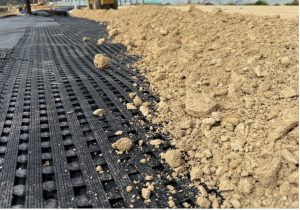
- Passive resistance
It occurs when soil particles become embedded in the pores or open structures of the geosynthetic, generating a mechanical connection. This mechanism is fundamental in geogrids.
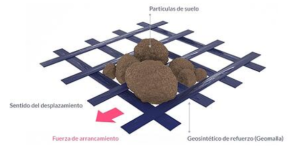
Typical applications:
- Geogrid-reinforced soil walls.
- Mechanical stabilization systems for bases and granular subbases in pavements.
- Friction
This mechanism is predominant in geotextiles and geogrids, where the resistance to relative movement between the soil and the geosynthetic is provided by friction at the interface.
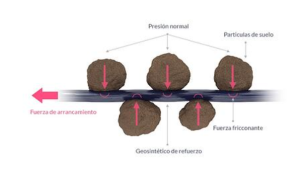
Influencing factors:
- Soil friction angle.
- Composition and texture of the geosynthetic.
- Compaction of the surrounding soil.
- Lockdown
Confinement refers to the ability of the geosynthetic to restrict lateral movement of the soil, increasing its stiffness.
FHWA Recommendations for Design and Evaluation
The FHWA provides specific guidelines in its handbook ".Geosynthetic Design and Construction Guidelines"to ensure optimum performance of reinforced systems. These include:
- Materials Characterization:
- Conduct laboratory tests to determine the mechanical properties of the geosynthetic and soil, such as tensile strength and friction angle.
- Interaction Analysis:
- Evaluate the joint behavior of the geosynthetic-soil system by means of direct shear and pull out tests in the laboratory, numerical models or field tests, considering factors such as stress, deformation and global stability.
- Design Criteria:
- Dimension the geosynthetics to comply with the specified safety factors, ensuring that they can withstand the expected loads without failure, i.e. applying the reduction factors that correspond to the chosen geosynthetic.
- Compatibility with Soil:
- Select geosynthetics that are compatible with the physical and chemical properties of the local soil.
- Quality Control and Supervision:
- Implement inspection programs during installation to verify proper placement and material integrity.
Best Practices in Projects
- Specific Project Design: Each structure has unique conditions, so it is essential to adapt the design to the specific characteristics of the site.
- Field Tests: Perform in situ tests and geotechnical instrumentation to evaluate the interaction between the geosynthetic and the soil under real loading conditions.
- Staff Training: Ensure that contractors and supervisors are trained in installation techniques for geosynthetics and soils in accordance with project requirements.
- Use of Advanced Technologies: Incorporate modeling and simulation software to predict system behavior and optimize design.
Conclusion
Reinforcement transfer mechanisms between the geosynthetic and the soil are critical to ensure the success of reinforced structures. Understanding how these mechanisms work and implementing recommendations such as those of the FHWA can maximize the efficiency and durability of the systems. The integration of best practices, along with a rigorous evaluation of project conditions, is key to achieving successful results in geosynthetic applications.