




Strategies for bed protection with geosynthetics
In hydraulic engineering, ensuring bed stability in rivers, canals and drainage works is a priority. The bed protection with geosynthetics has become a key strategy to mitigate problems such as erosion, scour and excessive flow velocities, which can lead to structural failure, property loss and severe environmental disturbance.
Why protect the streambed?
The bed of a channel or river is constantly exposed to flow energy. Under conditions of high velocity, section changes or presence of structures, the risk of local scour (around piles, abutments, culverts) or general scour (by progressive erosion of the bottom) increases.
If adequate protective solutions are not applied:
-
The riverbed loses its stability.
-
Waterworks may collapse.
-
The hydraulic and ecological balance is interrupted.
The geosynthetics have positioned themselves as key tools for designing durable and efficient solutions for riverbed protection. This blog presents a comprehensive approach to their use as part of bed protection strategies, considering scour analysis and velocity distribution in the channel.
PRE-ANALYSIS: THE BASIS FOR EFFICIENT DESIGN
Before implementing a geosynthetic solution, it is essential to perform a technical analysis that includes:
1. Speed distribution
Hydraulic models (HEC-RAS, Iber, Flow 2D) are used to identify the areas of greatest kinetic energy, where velocities exceed the bed sediment carrying capacity. It is important to consider the velocities associated with the peak flow. Hydraulic works are normally designed for a return period of 100 years.
2. Shear stress analysis
It allows to calculate if the flow can mobilize the particles in the bed. If the stresses exceed the shear strength of the soil, immediate protection is required. This is a fundamental parameter to determine the level of demand of the works and the thickness of the lining, in order to ensure that the tractive forces of the water do not destabilize the works.
3. Scour depth estimation
It is evaluated according to empirical formulas or physical models, especially in works with transverse structures or points of section change. For this purpose, it is important to know the granulometry of the site, the type of material carried by the riverbed and its hydrodynamic behavior.
SOLUTIONS WITH GEOSYNTHETICS FOR BED PROTECTION
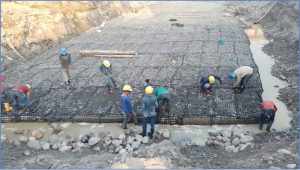
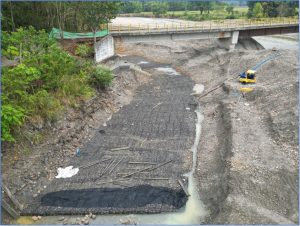
Confined rockfill mattresses with Geoestera hydromesh.
These are bank protection systems used to form protective structures at the water's edge and under water.
Advantages:
-
Continuous mass of high porosity.
-
They offer flexibility and hydraulic stability.
-
High capacity for energy dissipation.
-
They control wave formation and current rebound.
-
Ability to tolerate any natural environment of chemical, biological and mechanical degradation.
-
High durability and long-term resistance capacity.
Considerations:
-
Selection of the appropriate size of the mat and thickness of the mattress (shear stress and velocity analysis).
-
Selection of the length of the mattress in Geotextile Hydromesh (scour analysis).
-
Selection of the separation geotextile (verification of the resistance of the geotextile to punching and traction).
Applications:
-
Shore erosion control.
-
Protection against scour in bridge abutments.
-
Bed protection on bridge approaches.
-
High specification dams built in submerged condition or with mechanically unstable materials.
-
Channel lining.
2. Articulated Mattress
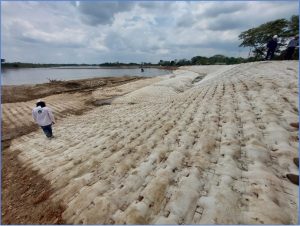
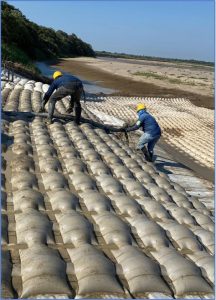
The Colchacreto Articulado textile formwork allows taking advantage of the benefits of concrete to cover surfaces exposed to erosion, allowing for a continuous and articulated covering that maintains the functional condition in the face of the effects of scour and offers a macrotexture similar to river pebbles, which controls the erosive power of the current.
Advantages:
-
Articulated blocks, joined by transverse and longitudinal reinforcement tendons, embedded in the hardened backfill mix.
-
High-strength fibers that allow adequate performance under concrete pouring and pumping pressures.
-
High permeability, thanks to the pore opening size that allows filtering excess water from the fine aggregate concrete mix.
-
They offer flexibility and hydraulic stability.
-
High capacity for energy dissipation.
-
They control wave formation and current rebound.
Considerations:
-
Traction forces check (shear stress and velocity analysis).
-
Selection of the length of the Articulated Mattress (scour analysis).
-
Selection of the separation geotextile (verification of the resistance of the geotextile to punching and traction).
Applications:
-
Shore erosion control.
-
Protection against scour in bridge abutments.
-
Bed protection on bridge approaches.
-
High specification dams built in submerged condition or with mechanically unstable materials.
-
Channel lining.
Conclusion
The bed protection with geosynthetics represents an evolution in the design of hydraulic works, incorporating resistant, sustainable and adaptable solutions to complex scour scenarios.
Thanks to their versatility and proven performance, geosynthetics can control erosion, stabilize structures and extend the life of hydraulic infrastructure. Proper consideration of variables such as velocity distribution and scour depth is key to ensuring efficient results.
In a context of hydrological variability and extreme phenomena, implementing strategies of bed protection with geosynthetics not only responds to technical criteria, but also to a strategic vision that prioritizes resilience and sustainability. For this reason, its application continues to consolidate as a reliable solution in highly demanding hydraulic projects.