




Resistance of geo-mesh hydromesh in severe conditions
How resistant are Geoestera hydromesh to severe hydraulic conditions?
The growing demand for geosynthetic containers, river embankment rehabilitation and erosion control in river banks and coastal areas has increased the use of GEOESTERA hydromesh for solutions to severe hydraulic conditions. In this type of applications, it is essential to know the resistance of Geoestera hydromesh, especially when abrasion generated by sand and gravel particles represents one of the main causes of deterioration. Abrasion test in severe conditions: how does it work?
Each hydromesh was installed inside a cylindrical chamber designed to generate a continuous turbulent flowwith permanent dragging of sand and gravel.
Test conditions:
-
Solids concentration: 6% of total tank volume
-
Average flow velocity: 2.08 m/s
-
Exposure time: 96 hours
After testing, the specimens were subjected to single rib tensile test (ASTM D6637) to determine the retained strength after wear.
Products evaluated
Five woven geosynthetics:
-
GEOESTERA 50 Hydromesh
-
GEOESTERA 80 hydromesh
-
GEOESTERA 150 Hydromesh
-
GEOESTERA 300 hydromesh
-
Geogrid GG90/30 (competition)
Key results of the study
The results show superior performance of Geoestera hydromesh over competing geogrids in both MD and TD directions.
Retained resistance after 96 hours in turbid streams
-
Geoestera 300 → TD: 97,8% | MD: 95,8%
-
Geothermal 150 → TD: 95.2% | MD: 92.7%
-
Geothermal 80 → TD: 92.2% | MD: 90.5%
-
Geothermal 50 → TD: 72.6% | MD: 90.1%
-
Competition → TD: 55.7% | MD: 68.9%
These results confirm that the GEOESTERA hydromesh retains its structural integrity even under extreme conditionsThe loss of resistance due to abrasion is lower.
Why does Geoestera hydromesh offer better performance?
Its superior performance is explained by:
-
High performance PET polymer
-
High initial resistance per rib
-
Optimized rib bonding compared to other woven products
-
Thickness and open area designed to minimize critical wear points
-
High-performance copolymer impregnation coating
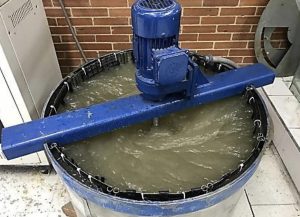
Figure 1. Abrasion test setup.
Impact on your projects: direct benefits
Typical applications:
-
Protection of river banks
-
Containment in coastal areas
-
Channel lining
-
Systems exposed to abrasion and particle entrainment
Advantages:
-
Increased durability and service life
-
Lower maintenance costs
-
Increased reliability in harsh hydraulic environments
-
Efficiency in erosion control under continuous wear
In summary:
✅ Longer system life
✅ Lower repair costs
✅ Increased operational safety
Conclusion
The hydromesh Geoestera demonstrate a outstanding abrasion resistance in severe operating conditions. Their design, high performance materials and laboratory tested behavior make them a reliable solution for projects where hydraulic wear is critical.
For more information on standards, testing and hydraulic applications of geosynthetics, you can consult the publications of the Geosynthetics Institute (GSI).