





BEHAVIOR OF GEODRAINS IN FILTRATION AND DRAINAGE (GEOTEXTILE AND GEORED)
Subsurface water flow generally threatens the useful life of pavement structures, affecting them in various ways. Precipitation flowing superficially over slopes can accumulate and infiltrate into the ground, causing saturation, affecting the bearing capacity of the structure, generating settlements that threaten its stability and contribute to the formation of cracks and subsidence. The proper implementation of underdrainage systems in pavements can mitigate these adverse effects, ensuring better durability and resistance to hydrological conditions. Pavement underdrainage systems play a crucial role in protecting against subsurface water damage, providing an effective solution for maintaining structural integrity and prolonging the service life of roadways.
Potential water ingress into the pavement structure is associated with seepage through the surface via cracks and joints, at the edges of the roadway, seepage from sections adjacent to the cut or embankment, and rising water tables (see Figure 1). Since the specific locations where water may enter the layers of the structure cannot be predicted, underdrain systems capable of protecting the full width of the pavement are needed.
The purpose of underdrainage systems is to reduce damage caused by excess water. Excess water generates an internal flooding condition of the pavement structural section, which produces hydrostatic pressures in cracks or voids; and also, causes detrimental changes in the bearing capacity of the structure. Road underdrainage is a system of vital importance to ensure the durability of pavement structures. By intercepting subsurface water, it prevents it from causing irreversible damage to the project. In addition, good water management in this type of structure significantly reduces maintenance costs.
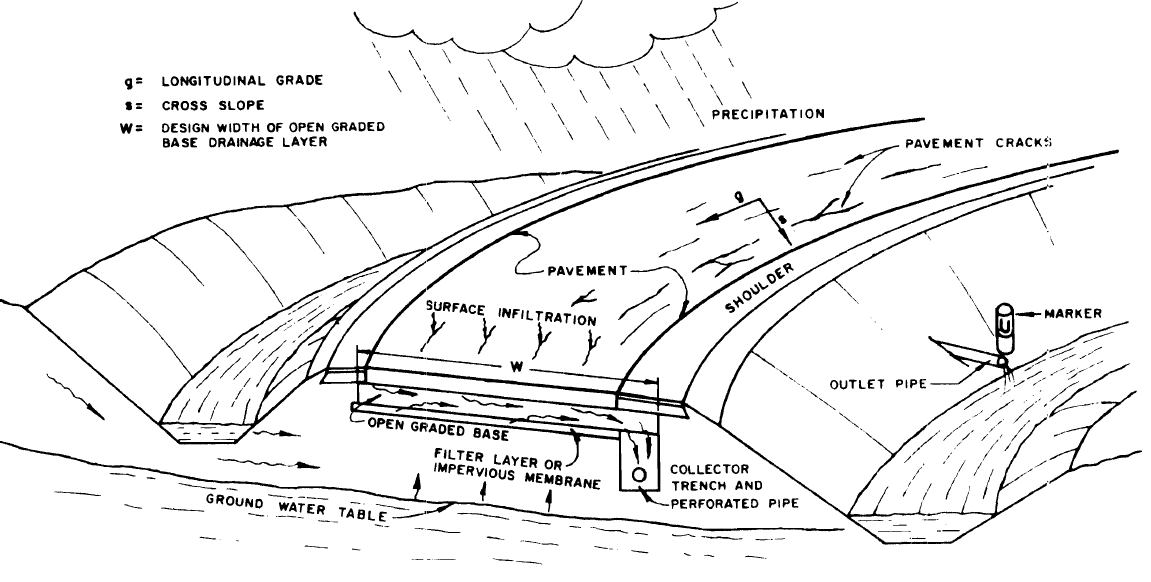 Figure 1. Subdrainage system in pavement structures.
In practice, longitudinal subdrainage systems are placed along the edge of the road, and/or transverse subdrains at the base of the pavement section.
The underdrain placed at the edges of the road captures the upward water flows and conducts them longitudinally (see Figure 2), while the transversal underdrain placed at the interface between the subgrade and the granular substructure, conducts the flows transversally towards the longitudinal underdrain (see Figure 3) complementing the system, thus preventing the access of water into the layers of the pavement structure while keeping the water table of the subgrade soil low.
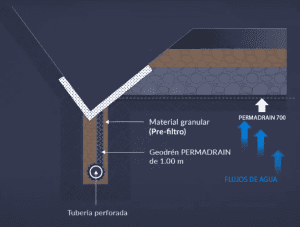
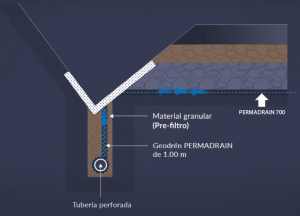 Figure 2. Yeahtheme of Longitudinal Horizontal.
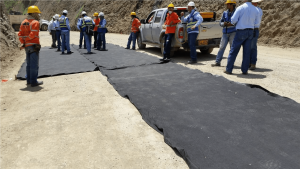
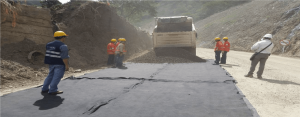
Figure 3. Geodrain PERMADRAIN for subgrade water table lowering
The geodrain PERMADRAIN is a geocomposite that presents in a single product an integral drainage system, consisting of an HDPE drainage medium (geonet) that offers high compressive strength, maintaining constant thickness under high load stresses and a non-woven geotextile filter medium that allows efficient water flow while retaining soil particles. The geodrain for the longitudinal subdrainage system has a bottom sleeve that houses a perforated corrugated pipe for subdrainage. DRAINPIPE which is in direct contact with the geonet, guaranteeing the direct delivery of the collected water and its efficient evacuation.