





Safety factors in reinforced soil walls: keys for stability
Reinforced soil retaining walls (SRF) function as a composite system in which the soil and the reinforcement elements work together to resist the stresses. For this reason, the analysis of the safety factors in reinforced soil walls cannot be approached from a single criterion, but as a set of verifications that guarantee the overall balance of the structure.
Their stability depends on the interaction between loads, geometry, soil properties and hydraulic conditions. In this type of system, both external and internal limit states must be evaluated consistently to ensure adequate performance over time.

Safety factors against slippage
Sliding corresponds to the possibility of the reinforced block to move horizontally on the foundation soil. This analysis is performed by comparing the lateral thrust of the retained soil, including overloads and seismic effects when applicable, with the resistance available at the base.
This resistance depends mainly on the friction between the soil and the foundation, which is directly influenced by the effective resistance parameters. In conditions where there is high humidity or the presence of a water table, the increase in pore pressure can significantly reduce the friction capacity. Therefore, it is essential to consider adequate drainage conditions to avoid uncontrolled increases in lateral pressures.
Rollover safety factors
Overturning is evaluated as the tendency of the wall to rotate around its front edge. For verification, the moments generated by the earth thrust are compared with the stabilizing moments produced by the weight of the reinforced block and the vertical loads.
Beyond the value of the factor of safety, it is key to analyze the position of the load resultant at the base. Excessive eccentricity can cause loss of contact in part of the foundation and generate non-uniform stress distributions. Under proper design conditions, it is sought that this resultant remains within the middle third of the base.
Bearing capacity in reinforced soil walls
The purpose of the bearing capacity verification is to ensure that the foundation soil is capable of supporting the loads transmitted without reaching its ultimate strength or showing excessive deformations.
This analysis involves comparing the effective pressures under the base with the allowable capacity of the soil. In compressible soils, not only the resistance must be evaluated, but also the total and differential settlements, since these can affect the geometry of the wall and generate stress redistributions not foreseen in the design.
Internal safety factors in MSE walls
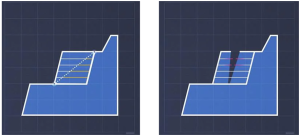
Internal analysis is one of the most characteristic aspects of MSE walls, since it evaluates the behavior of the soil-reinforcement system against possible failure surfaces within the reinforced block.
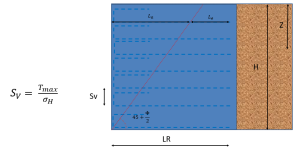
From an assumed failure geometry, the tensile forces to be resisted by the reinforcement at each level are determined. These forces are used to verify, first, that the tensile strength of the reinforcement is sufficient, considering reductions associated with installation damage, chemical or biological effects of the soil and long-term creep phenomena.
Secondly, the pullout resistance is evaluated, which depends on the anchorage length outside the active zone allowing the development of the friction necessary to avoid the extraction of the reinforcement. This soil-reinforcement interaction is directly related to the material properties and the level of confinement, so the quality of the backfill plays a fundamental role.
Spreading of reinforcements and face behavior
Spreading between reinforcement layers directly influences stress distribution and deformation control within the system. Excessive spacings can generate localized behaviors that affect the stability and appearance of the facade.
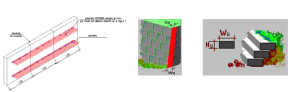
In walls with blocks or panels, it is also necessary to evaluate the stability of the face, including the connection between the facade elements and the reinforcements, as well as possible sliding or rotation mechanisms between components.
Overall system stability
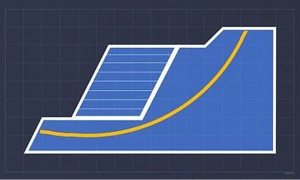
In addition to local checks, it is essential to evaluate the overall stability of the system by analyzing deep failure surfaces that may involve both the wall and the foundation soil.
This type of analysis, generally performed using limit equilibrium methods, allows the identification of critical conditions that are not evident in the individual checks. It must also consider factors such as seismic conditions, drainage, quality of materials and construction process.
Conclusion
The safety factors in reinforced soil walls must be understood as an integral system of verifications that, as a whole, guarantee the stability of the structure.
The behavior of the wall does not depend on a single mechanism, but on the interaction between external stability, internal resistance and environmental conditions. Therefore, both design and execution must be approached in a rigorous manner, considering that even small variations in materials or construction processes can significantly impact the final performance. The design criteria for reinforced soil walls have been extensively documented in the Federal Highway Administration (FHWA).