





Reflection of cracking in asphalt pavements
He reflection of cracking in asphalt pavements is one of the main deterioration mechanisms in rehabilitated flexible structures. This phenomenon occurs when cracks or joints in the existing pavement propagate into the new asphalt overlay.
Although traditional interventions usually focus on overlay placement or surface replacement, effective control must address the source of the problem, which is associated with concentrations of tensile and shear stresses in discontinuities in the existing structure.
In this context, the geogrids for asphalt reinforcement, especially polyester woven geogrids, have established themselves as an efficient solution to control crack propagation and improve pavement structural performance.
Why is the reflection of cracking in asphalt pavements generated?
When an asphalt overlay is installed over a cracked pavement, the existing discontinuities allow for relative vertical and horizontal movements that generate stress concentrations in the new layer.
This phenomenon is mainly induced by:
- repetitive traffic loads
- thermal variations (expansion and contraction)
- aging of the existing asphalt mix
- deformations in the granular structure
As a result, tensile and shear stresses develop in the lower part of the overlay that favor the initiation and propagation of cracks towards the surface.
This deterioration is accelerated with the aging of the asphalt binder, since the mix loses flexibility and capacity to dissipate stresses, increasing its susceptibility to cracking under cyclic loads.
How do geogrids for asphalt reinforcement work?
Geogrids for asphalt reinforcement act as structural elements installed between layers of asphalt mix. Their main function is to control crack propagation and improve stress distribution within the system.
In particular, woven geogrids manufactured with high tenacity polyester (PET) present:
- high resistance to installation temperatures
- high modulus in tension
- efficient behavior under cyclic loads
- open geometry allowing interaction between layers
This configuration allows redistribution of the tensile and shear stresses induced in the pavement, improving its structural response.
Cracking reflex control mechanisms
The performance of geogrids is based on several complementary mechanisms:
Redistribution of efforts
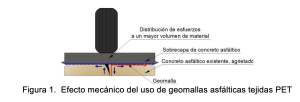
The geogrid distributes stress concentrations over a larger area, reducing localized stresses and decreasing the rate of crack propagation.
Tensile reinforcement of the asphalt layer
Absorbs horizontal stresses generated by repetitive loads, improving the fatigue behavior of the overlay.
Interface shear strength
The open structure allows contact between layers, increasing adhesion and reducing the risk of slippage or detachment.
Performance under cyclic loads
Tests developed by the Texas Transportation Institute (TTI) have shown that the use of geogrids increases the number of cycles required for crack propagation, increasing pavement durability.
Why use high tenacity polyester (PET)?
The performance of a geogrid depends directly on its mechanical properties and fatigue behavior.
High tenacity polyester (PET) offers:
- high tensile strength
- excellent cyclic load behavior
- elastic resilience
- chemical and mechanical stability
- reduced susceptibility to brittle cracking
These properties allow the system to maintain its reinforcing capacity even as the asphalt mix ages.
Benefits of using geogrids in asphalt pavements
The implementation of geogrids for asphalt reinforcement allows:
- reduce the cracking reflex
- increase the service life of the pavement
- improve fatigue resistance
- optimize stress distribution
- reduce maintenance interventions
- improve performance in heavy traffic
In addition, they have adequate thermal resistance and efficiently support the processes of installation and compaction of hot asphalt mixtures.
Conclusion
He reflection of cracking in asphalt pavements is a recurrent problem in rehabilitation processes by means of overlaying.
High tenacity polyester woven geogrids control this phenomenon through stress redistribution, structural reinforcement and improved interlayer adhesion.
Its cyclic loading behavior and high mechanical strength contribute significantly to increasing the durability and performance of modern pavements.