





Drainage in reinforced soil walls: the detail that can cause the most problems
In reinforced soil wall projects, attention is often focused on the length of the reinforcements, the load-bearing capacity, or the overall stability. However, one of the aspects that causes the most problems on-site and throughout the system’s service life is often a seemingly simple detail: drainage.
Most of the problems that arise in these types of structures are directly or indirectly related to the presence of water. Unaccounted-for hydrostatic pressures, saturation of the backfill, loss of fine material, excessive deformation, and deterioration of the facade are associated problems that usually stem from a common cause: inadequate drainage.
Why is drainage important in reinforced soil walls?
Reinforced soil walls function by exploiting the interaction between the soil and the reinforcing elements. For this mechanism to work properly, the backfill must maintain relatively controlled moisture conditions.
When water accumulates behind the wall, lateral pressures increase, soil resistance decreases, and deformations begin to occur, ultimately affecting the structure's performance.
In many cases, the wall meets the design safety requirements but still exhibits deformations or failures due to hydraulic issues that were not properly addressed.
Drainage systems for reinforced soil walls
Depending on the project conditions, different drainage systems can be implemented.
Longitudinal drain in reinforced soil walls
One of the most common types is the longitudinal drain at the base, which typically consists of a perforated pipe surrounded by filter material, designed to collect and convey seepage water to discharge points.
Vertical drains or drain pipes
Vertical drains are also installed in the backfill as drainage chimneys, constructed with clean granular material, which help intercept water flowing down the slope and direct it toward the main drain.
Drainage geocomposites behind the facade
In some projects, drainage geocomposites are installed behind the facade to remove localized water accumulation; these systems require special care because they can easily become clogged when fine particles migrate.

Figure 1. Effect of drainage on MSR.
Surface water management matters too
Another aspect that is often overlooked is surface water management. Many failures occur because runoff ends up flowing directly behind the structure.
Poorly constructed or dilapidated gutters, lack of maintenance, missing downspouts, or inadequate surface slopes allow for continuous water seepage, which eventually saturates the back of the wall.
For this reason, surface drainage is just as important as internal drainage.

Figure 2. Drainage in MSR.
Common drainage mistakes during construction
In theory, most designs include adequate drainage systems. The problem usually arises during construction.
It is common to find drainage materials contaminated with fine soil due to improper handling on-site, pipes without sufficient slope, or improperly installed geotextiles that no longer function properly as a filter.
It also happens that drainage outlets become blocked due to subsequent urban development or are simply never built in a functional manner.
In other cases, the systems work well at first, but eventually become clogged due to a lack of maintenance.
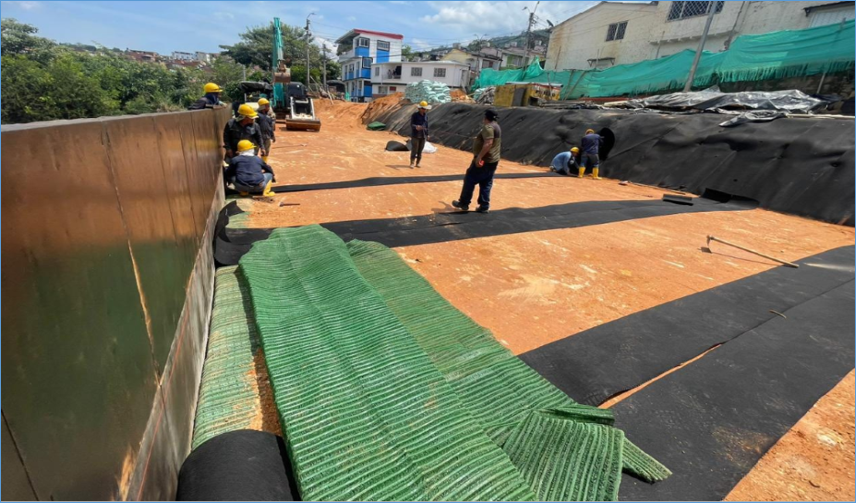
Figure 3. MSR horizontal subdrain.
Early signs of water-related failure
Early warning signs usually appear long before a major problem occurs.
Bulges in the facade, persistent moisture, water runoff, fine particle erosion, or settlement at the crown typically indicate the presence of uncontrolled water within the system.
Even the growth of vegetation in specific joints or areas can be a sign of constant moisture buildup behind the wall.
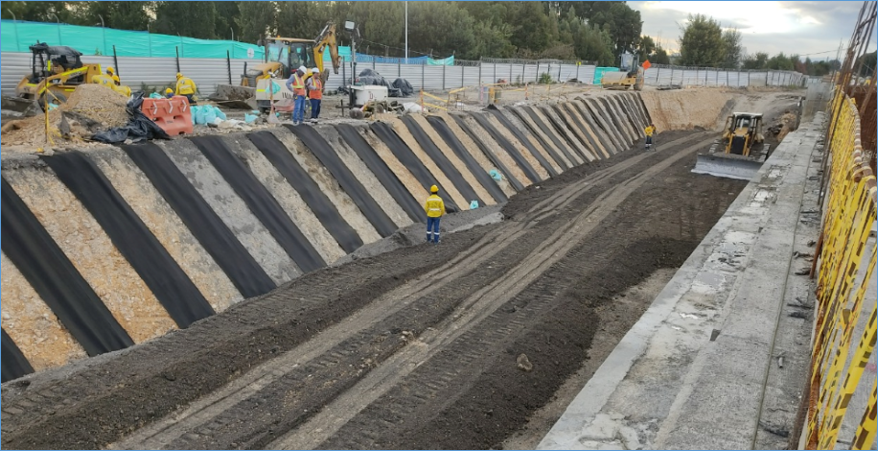
Figure 4. Subdrainage in the MSR backrest.
Conclusion: Drainage should not be treated as a secondary consideration
In many projects, drainage ends up being treated as a secondary consideration that can be addressed during construction. That is precisely one of the main causes of problems in reinforced soil walls.
A sound structural design does not guarantee the structure's proper performance if the hydraulic system fails.
Therefore, in addition to the design, it is essential to ensure quality control during construction, proper installation of filters and drains, proper management of surface water, and regular inspections.
In structures like these, water rarely forgives even minor mistakes, and often the detail that seems simplest ends up causing the most problems.