




Geomesh Hydromesh: Hydraulic Control Against Scouring and Construction Guidelines for Proper Installation
Undermining is one of the main problems affecting hydraulic structures, canals, slopes, and drainage systems. This phenomenon occurs when the force of the water dislodges soil particles, leading to progressive erosion, loss of stability, and structural damage.
To manage these types of processes, the HIDROMALLA GEOESTERA is an essential material due to its ability to contain rockfill, creating highly efficient systems for dissipating hydraulic energy, stabilizing surfaces, and protecting the ground from runoff and concentrated flows.
HIDROMALLA GEOESTERA is used to manufacture mattress-style and box-style rock-fill containers, which are filled with rock fragments to create a modular system that conforms to the contours of the slope while blending naturally with the site’s soil and vegetation.
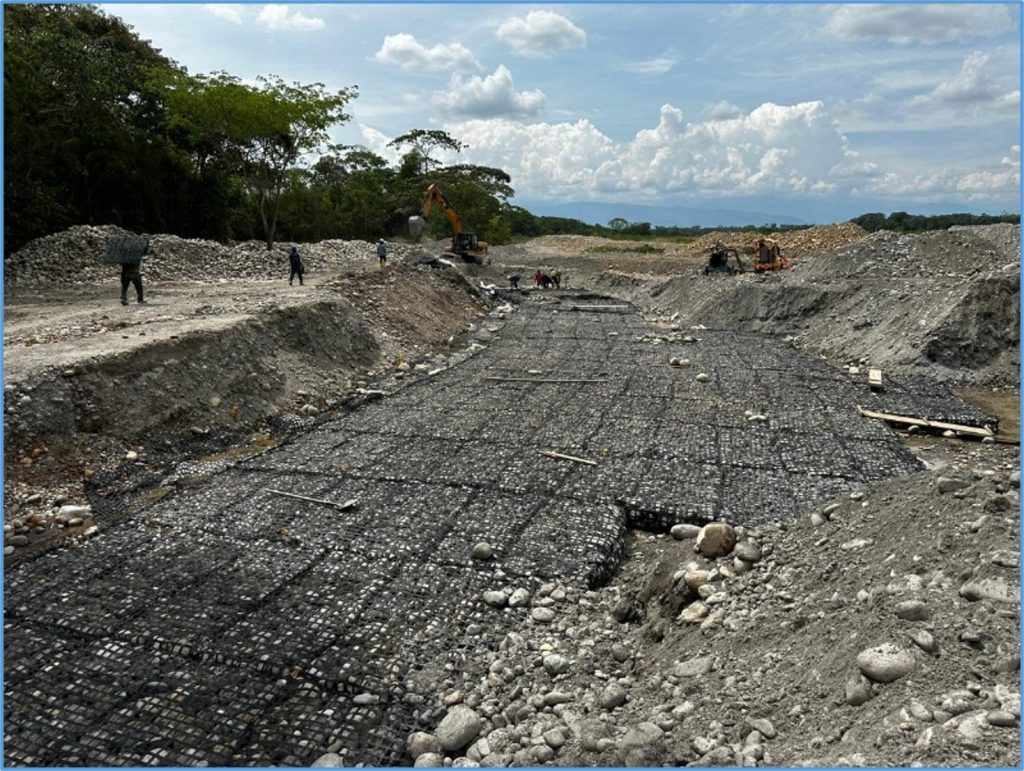

Geomesh Hydromesh System for scour control and hydraulic protection.
Advantages of systems made with Hidromalla Geoestera
The advantages of these systems can be summarized as follows:
• They reduce the flow velocity.
• They dissipate hydraulic energy.
• They promote revegetation.
• Erosion processes are reduced.
Applications of the HydroMesh Geomat
The main applications include:
• Erosion control along riverbanks.
• Protection against scouring at bridge abutments and along the riverbed.
• Lining of channels.
• Bank protection at river or marine piers.
• Lining of hydraulic structures (dikes, jetties, embankments).
How do they control scouring?
Confined rockfill containers create a porous medium that reduces flow energy and water velocity, thereby decreasing the shear stress on the soil. This helps minimize particle detachment and the progression of erosion.
The key aspects of this process are summarized as follows:
Shallow confinement
The system keeps the soil in place even during heavy rain or high water flow.
When combined with vegetation, the roots and the geomat work together to increase hydraulic stability.
Flexible protection
Unlike rigid solutions, rockfill containers reinforced with Hidromalla Geoestera better adapt to ground settlement and deformation, reducing the risk of localized failure.

Confined rockfill containers for scour and erosion control.
Hydraulic design criteria
When selecting the appropriate system, the following factors should be considered:
Flow rate
The higher the velocity, the greater the erosive power of the water. The system must be able to withstand the design hydraulic conditions.
Pending
Steep slopes increase hydraulic energy and require more robust fastening and anchoring systems.
Type of flooring
Fine, low-cohesion soils are more susceptible to erosion.
Weather conditions
It is essential to take into account extreme rainfall, peak flows, and hydraulic variations specific to the project, as well as the occurrence of atypical phenomena associated with climate change.
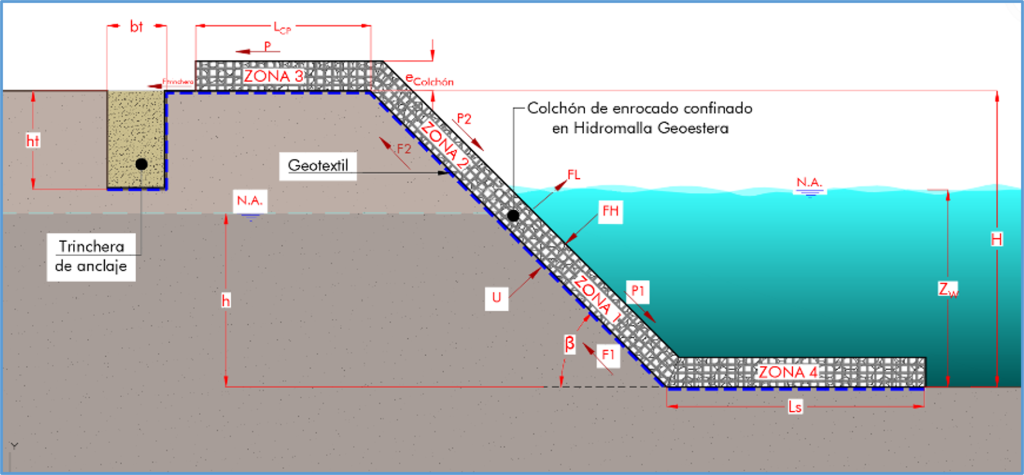
Hydraulic design of a rockfill mattress confined in Hidromalla Geoestera for scour control and slope protection.
Construction guidelines for proper installation
Site preparation
The surface must be:
• Contoured.
• Compacted.
• Free of sharp objects.
• No loose parts.
Poor preparation can cause cavitation and surging.
Installation in the direction of flow
Rockfill containers should be installed in the direction of the main water flow to improve their hydraulic stability.
Installation of a separation geotextile
Before installing the lining, it is important to install the geotextile to control the migration of fine particles.
Anchoring and counterweight system on the crown
A counterweight anchoring system is recommended to ensure that sliding forces and the drag force of the water are counteracted.
Border and Transition Control
Inlets, outlets, and changes in slope are critical areas where hydraulic energy tends to be concentrated. These areas require reinforcement and special construction oversight.
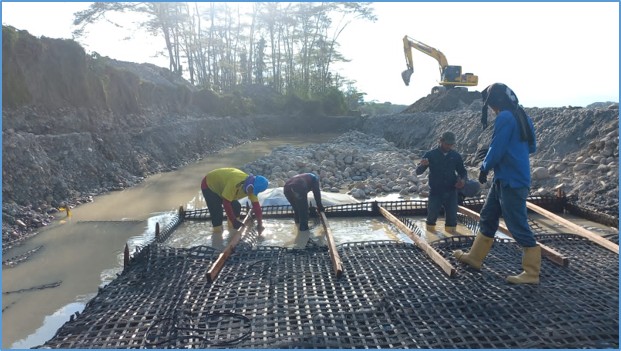
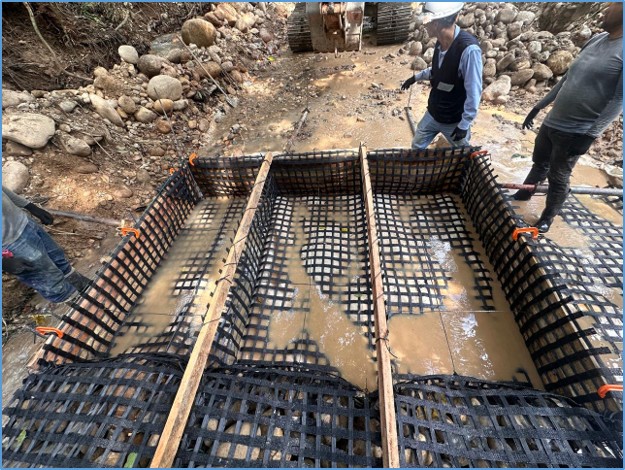
Installation of Hidromalla Geoestera
Common installation errors
Some of the most common faults include:
• Installation on unstable surfaces.
• Lack of containment of the fill material (alluvial material).
• Insufficient anchors and counterweights.
• The necessary connections between modules are not established to ensure that the system operates as a single, integrated unit.
• Design that does not take extreme events or previous studies into account.
Most hydraulic problems are caused by construction errors rather than material defects.
Advantages of riprap containers
• A continuous, highly porous material.
• Flexibility and hydraulic stability.
• Durability and long-term resilience.
• High energy dissipation capacity.
• Control of wave formation and current rebound.
Benefits of the HydroMesh Geomat
• High mechanical strength.
• Abrasion-resistant.
• Weather-resistant.
• It does NOT corrode.
Conclusion
The Hidromalla Geoestera facilitates the implementation of efficient systems for scour control and surface protection in infrastructure and water management projects, which are based on:
• A proper hydraulic analysis.
• Choosing the right system.
• Proper anchor design.
• The quality of on-site installation.
When these criteria are properly implemented, the result is safer, more sustainable, and longer-lasting hydraulic solutions.