





FORTGRID BX Geogrid Reinforcement Mechanisms
The use of geosynthetics has revolutionized the way pavement structures, embankments, working platforms and other granular soil solutions are designed and constructed. In particular, biaxial woven polyester biaxial geogrids have FORTGRID BX stand out as one of the most effective solutions to improve their structural performance, making them fundamental materials for the achievement of efficient and sustainable infrastructures.
geogrids FORTGRID BX are structures made of ribs or straps of high tenacity polyester multifilaments, arranged in two orthogonal directions. After weaving, they are impregnated with a material that provides rigidity, mechanical protection against damage during installation and protection against UV and aggressive chemical environments. The high tenacity polyester (PET) used in these geogrids provides excellent tensile strength, low deformation, long-term mechanical stability, resistance to high temperatures and stability under cyclic loading.
In this blog, the main geogrid reinforcement mechanisms are described in detail. FORTGRID BX for granular layers.
- RESTRICTION TO LATERAL DISPLACEMENT
One of the main reinforcement mechanisms generated by geogrids is the lateral restraint of the granular aggregate. This phenomenon occurs when the geogrid prevents the horizontal displacement of the soil particles, transferring their tensile strength to the aggregate, thereby increasing the shear strength of the soil. This occurs mainly through two effects that occur in the soil-geosynthetic interaction:

Figure 1. (a) passive resistance transfer (b) friction transfer.
a. Passive Resistance Transfer (Aggregate Locking)
When a load is applied to a geogrid-reinforced granular layer, the aggregate particles attempt to move laterally. However, when they encounter the openings in the geogrid, these particles are positioned within the openings. This contact creates a kind of "mechanical anchorage", also known as "mechanical anchorage". link of the aggregate.
This mechanical interlock generates a passive resistance that opposes the lateral movement of the aggregate. The result is a confinement that significantly improves the stiffness of the soil-geogrid system. This mechanism is most effective when the size of the aggregate allows efficient locking within the mesh cells, maximizing the interaction between the two materials.
b. Friction Transfer
Another important mechanism is the friction between the soil particles and the geogrid straps. As the soil is stressed, part of the load is transferred through friction at the soil-geosynthetic interface. Thanks to the width of the straps and the rough surface of the polyester fabric, this friction is enhanced, increasing the load-carrying capacity of the soil-geogrid assembly.
Both mechanisms combined-lock and friction-increase the stiffness of the granular layer, reducing deformation, settlement and the propagation of vertical stresses to lower layers.
- TENSIONED MEMBRANE EFFECT
The second relevant mechanism is the tensioned membrane effect, which is activated when the soil-geogrid system undergoes vertical deformations.
When a granular layer is subjected to a load, and it is supported on a geogrid placed on a soft subgrade, the geogrid tends to deform downward, generating a concave curvature. This deformation produces stresses within the plane of the geogrid, similar to the behavior of a tensioned membrane.
Due to their geometry, these stresses generate an upward force that contributes to the support of the applied load. The higher the tensile stiffness of the geogrid (a key property of polyester), the more efficient this stress redistribution will be.
This effect is especially relevant in conditions where the subgrade has low bearing capacity and solutions are required to better distribute loads, minimizing excessive deformations.
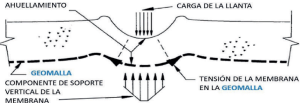
Figure 2. Reinforcement mechanism by the tensioned membrane effect.
- INCREASED SUPPORT CAPACITY
The use of geogrids FORTGRID BX generates a significant increase in the bearing capacity of the granular structure. The presence of the geogrid FORTGRID BX modifies the geometry of the fault surface. Reducing its depth and widening it laterally. This is the result of improving lateral confinement and limiting the movement of particles, achieving a more efficient redistribution of loads, which translates into: reduction of settlements, less permanent deformation, greater durability of the structure and better behavior in the face of cyclic loads.
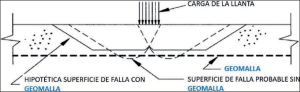
Figure 3. Increased bearing capacity within a pavement structure.
In summary, the use of biaxial geogrids FORTGRID BX allows for a reduction in the thickness of the granular pavement layers, which represents savings in materials, transportation and construction time. Understanding and correctly applying these reinforcement mechanisms is key for any civil engineer or designer seeking to optimize the behavior of granular soils under demanding conditions.