




Efficient geosynthetic bank protection solutions
The shore protection solutions in rivers, canals and water bodies are essential to address erosion. This problem represents both an environmental and infrastructure challenge. Today, more durable and sustainable alternatives are being sought.
In this context, the geosynthetics have gained prominence. These materials make it possible to protect, stabilize and restore riverbanks with less environmental impact compared to traditional concrete solutions.
Geosynthetics are synthetic materials designed to interact with the soil, providing reinforcement, filtration, separation, drainage or containment functions. In the field of bank protection, they allow a less invasive intervention, more adaptable to the conditions of the environment, and with a greater potential for ecological integration.
In this blog we will explore two innovative solutions with geosynthetic materials: GEO-MESH HYDROMESH AND ARTICULATED MATTRESS, analyzing its functionality, impact on carbon footprint reduction, and its role in the establishment of vegetation in the medium term.
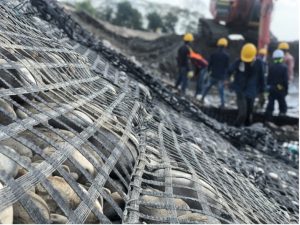
The GEOESTRAL HYDROMELis a biaxial mesh used to form mattress-shaped or box-shaped rockfill containers to control lateral erosion and scour phenomena in rivers. It is manufactured from high tenacity polyester and impregnated with a copolymer that makes it highly resistant to abrasive processes and increased traction forces in water bodies.
The roll-up containers offer the following advantages:
- Immediate erosion and scour control.
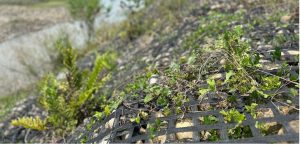
- Vegetation promotion: its open structure allows roots to develop and anchor, stabilizing the soil in the long term.
- Application in sloping areas: ideal for slopes, canals and river banks.
Environmental Impact:
- Carbon footprint reduction: unlike concrete structures, they generate fewer emissions, considering that alluvial material from rivers can be used.
- Natural vegetation: the porous medium that generates the confined rockfill with the GEOESTRAL HYDROMEL promotes natural revegetation, fully integrating into the ecosystem.
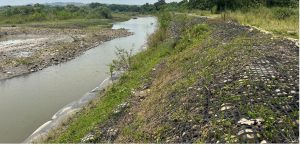
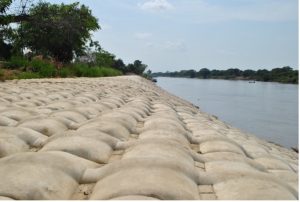
The following alternative is the textile formaleta ARTICULATED COLCHACRETOconsidered as an alternative for the conformation of flexible coatings, implemented in hydraulic protection structures against the abrasive action of water and scour in the bed of rivers, lakes and seas, where it is not available in rockfill, when filled with fine aggregate concrete.
The concrete placed in the formwork allows obtaining a continuous lining made up of interconnected blocks that adapt to the shape of the terrain. The macro texture achieved is similar to pebbles, thus dissipating the energy of the flow when in contact with it. The formwork has reinforcement tendons in both directions, which are embedded in the concrete mix aligned to the middle plane of the lining, increasing its integrity and allowing it to adapt to any deformation or irregularity of the terrain.
Advantages:
- High hydraulic resistance: withstands high flow velocities and extreme runoff conditions.
- Adaptability to the terrain: its articulated structure allows differential settlements without fractures.
- Fast and safe installation.
Environmental Impact:
- Lower volume of concrete: it has a yield of 14 m2 per m3 of mix, controlling the amount of cement (one of the largest emitters of CO₂ in construction).
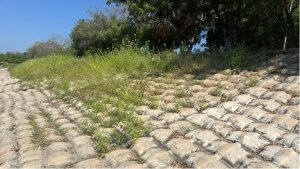
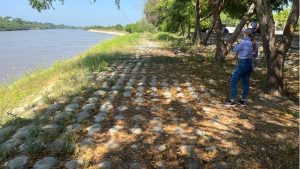
- Possible incorporation of vegetation: it can allow plant growth in the filter points, by accumulation of sediments, favoring aesthetics and biodiversity.
Conclusions:
Solutions based on geosynthetics, such as the GEOESTRAL HYDROMEL and the ARTICULATED COLCHACRETO offer a technically and environmentally responsible response to the problem of bank erosion. By significantly reducing the carbon footprint and promoting integration with the surrounding ecosystem, these technologies establish themselves as key strategies that promote green infrastructure and ecological engineering.