





In which cases should the subgrade be reinforced with Geosynthetics?
In road infrastructure projects, one of the most important aspects is to guarantee pavement stability with geosynthetics. This aspect is taken care of by the subgrade soil that, in some cases, may not be sufficiently resistant or stable, compromising the useful life of the pavement and the service condition of the road. For this, one of the most effective solutions is the use of geosynthetics for its reinforcement.
What is subgrade soil?
The subgrade soil is the natural material on which the pavement structure is placed. In simple terms, it is the soil that lies underneath the layers of the pavement. The main function of the subgrade is to provide adequate support for this structure, which is designed according to its bearing capacity to adequately distribute the loads applied by traffic.
If the soil has insufficient bearing capacity or undergoes volumetric or strength changes due to changes in moisture content (as occurs with expansive soils), it can cause failures, evident in the form of deformations, settlements and cracks in the pavement, which would compromise its durability. Therefore, it is crucial to properly evaluate the characteristics of the subgrade soil before starting any road project.
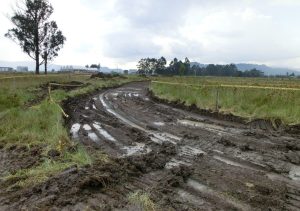
Photograph 1. Subgrade with low bearing capacity.
The bearing capacity of the subgrade can be determined in terms of its CBR (California Bearing Ratio) value or its undrained shear strength.
What are geosynthetics and how do they work?
These are materials that are used in civil engineering, particularly in geotechnics, pavements, hydraulics, erosion control Geosynthetics are designed to ensure pavement stability and properties, while providing efficient solutions to a variety of geotechnical problems.
Geosynthetics can play several roles in a road project. Particularly at the subgrade level they can contribute:
- Reinforcement: Because of their tensile strength, high modulus geotextiles and biaxial geogrids reinforce the subgrade soil. By acting as a kind of tensioned membrane, they distribute the loads applied by traffic, which helps prevent the formation of cracks or deformations in the pavement.
- Filtration: The geotextiles allow water to pass through in a controlled manner, preventing water from being trapped in the granular structure and in the soil, avoiding the generation of excess pore pressure that affects shear strength.
- Separation: The geotextiles They also perform the function of separation, guaranteeing the thickness of the first granular layer and preventing the migration of fine particles into the granular layers.
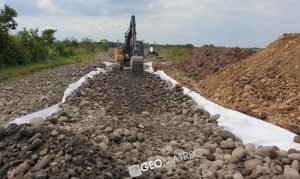
Photograph 2. Implementation of a geotextile for the reinforcement, separation and filtration of subgrade with low bearing capacity.
Geosynthetics are efficient because they are easy to install, offer a durable solution and provide superior long-term performance, with less need for maintenance compared to other reinforcement techniques.
When is it necessary to reinforce the subgrade soil with geosynthetics?
- Floors with low load-bearing capacity: when the soil does not have sufficient strength to support the weight of vehicular loads. This condition refers to CBR values less than 3% or undrained shear strength values less than 90 kPa.
- Unstable or expansive soils: mainly cohesive soils in which a clayey matrix predominates, are soils that can expand or contract depending on the moisture content, causing movements and deformations in the pavement.
- Saturated or high humidity soils: Soils that do not drain adequately can experience a decrease in their resistance, generating differential settlements.
- Pavements in areas with heavy traffic: when designing a pavement that must support a high volume of load, it is crucial to ensure a solid base.
- Areas prone to landslides or erosion: in areas with high slopes or unstable terrain, geosynthetics can improve skid resistance.
Benefits of using geosynthetics for subgrade soil reinforcement
- Cost reduction: by improving soil quality with a lower investment than other stabilization techniques.
- Improved bearing capacity: increasing strength and avoiding premature pavement failure.
- Differential settlement control: prevents irregular deformations in the pavement due to soil instability.
- Durability and sustainability: geosynthetics are inert materials resistant to attack by microorganisms, chemicals and other external factors.
- Fast implementation: compared to other stabilization methods, the use of geosynthetics is faster and more efficient.
Conclusion:
It is important to ensure the stability of the geosynthetic pavement and provide road longevity, especially in unfavorable soil conditions or high traffic projects. Its implementation not only improves the load capacity and resistance of the pavementIt also increases service life and reduces long-term maintenance costs, making it a valuable option in modern road engineering.
SUCCESS CASES
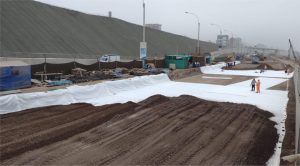
Photograph 3. Costa Verde, Lima-Peru.
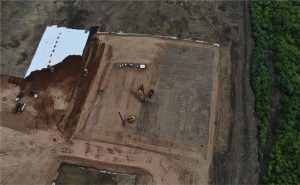
Photograph 4. Gatun Electric Generating Station, Panama.