





GEOSYNTHETICS FOR GEOTECHNICAL ENGINEERING
GEOSYNTHETICS FOR GEOTECHNICAL ENGINEERING
Geomatrix high tenacity polyester geosynthetics for geotechnical engineering are high performance materials specially designed to provide technical and economic advantages in the reinforcement of soils in the formation of earth structures. This solution has been positioned thanks to its application facilities for projects with difficult access, compressible foundation soils, low bearing capacity and susceptible to erosion, among others.
The inclusion of geosynthetic layers for geotechnical reinforcement between layers of compacted soil increases the shear strength of the whole, achieving more stable geotechnical structures.
PULL OUT RESISTANCE TEST FOR SOIL REINFORCED WITH GEOMETRICS
Geotechnical engineering has advanced significantly in recent decades, especially in the field of soil reinforcement. One of the most notable developments is the use of geogrids, which are geosynthetic materials designed to increase soil shear strength, controlling deformations and increasing bearing capacity.
In the case of soil reinforcement in the formation of retaining walls or steep slopes, geogrid reinforcement provides a horizontal component of reinforcement that is capable of handling the horizontal thrusts of the sliding mass. The length of the geogrids must be sufficient to anchor behind the determined failure surface guaranteeing the stability condition. The anchorage length is determined from the soil-geogrid interaction measured in the pull out or pull out resistance test, which yields the value of the interaction coefficient with which the anchorage length is calculated.
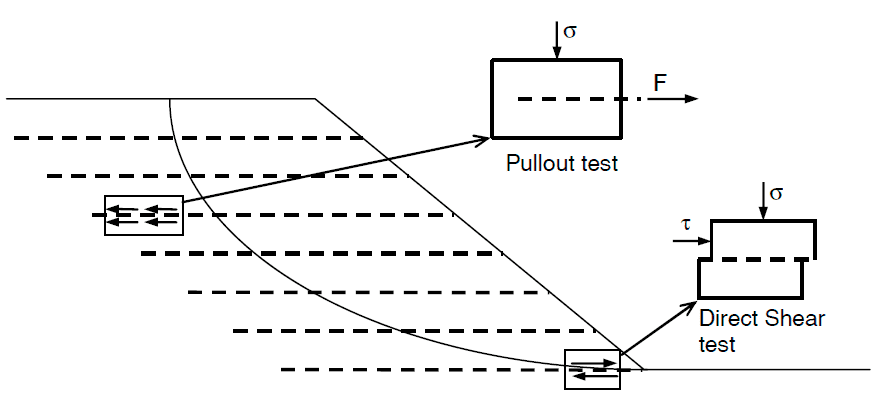
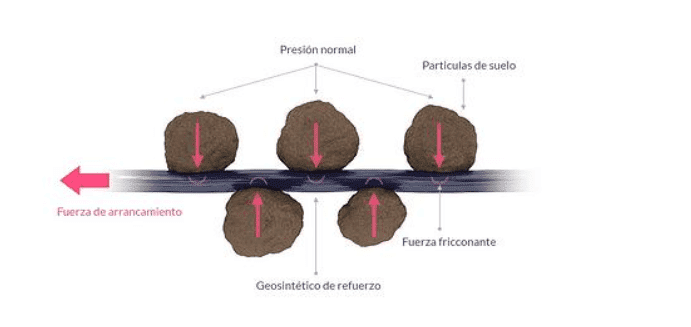
The trials of pull out are performed to determine the pull-out resistance of geogrids when subjected to a tensile force. under different confinement scenarios. Typically this test is performed under the standard ASTM 6706, which establishes procedures to conduct testing safely and effectively.
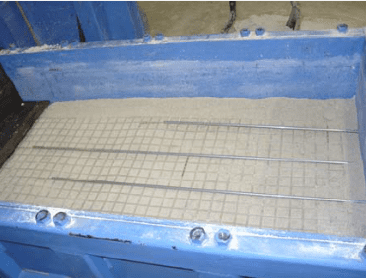
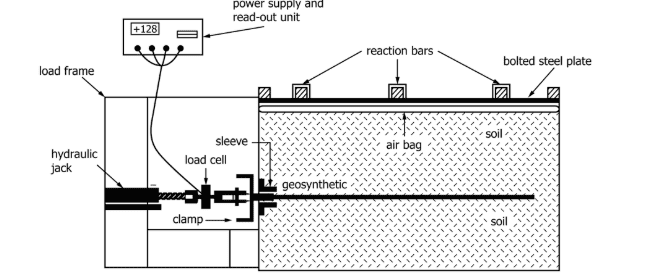
The pull out test is performed by inserting a section of geogrid into the soil and applying a tensile force until pull out occurs or until the specified maximum force is reached. During the test, the force required to pull out the geogrid is measured and the corresponding deformation is recorded. This data is crucial for the design of reinforced soil structures, as it provides information on the interaction between the geogrid and the soil.
The performance of pull out tests is vital for the design of reinforced soil walls. These tests allow verification of the tensile strength of the reinforcement and the pull out resistance, two critical factors in the design of these structures. In addition, pull out tests help to model geotechnical parameters and perform back-calculation analysis to optimize the results of existing projects.