





PET high modulus geotextile for CBR less than 3%
When to use high modulus PET geotextile in the subgrade of a pavement?
In road projects, the use of PET high modulus geotextile in subgrades with CBR < 3% becomes a critical issue in pavement design. In these cases, the low bearing capacity of the soil not only increases the required thicknesses, but also increases the risk of localized failures during construction and, at the service stage, the occurrence of permanent deformations, material contamination and accelerated loss of serviceability.
Under these conditions, the use of high modulus PET geotextiles can be essential. Their specification must respond to clear mechanical criteria and not to generic catalog decisions.
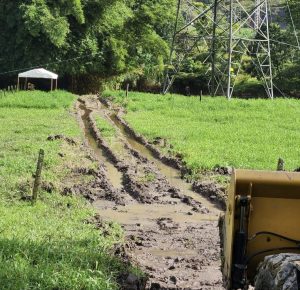
The structural problem when the CBR < 3%
He PET high modulus geotextile in subgrades with CBR less than 3% is an effective tool. Mechanically, this implies:
- Low resilient modulus.
- High deformability under repeated loads.
- Sensitivity to humidity variations.
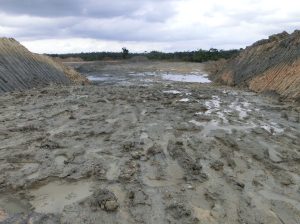
When a granular layer is placed directly on this type of subgrade, high shear stresses occur at the interface. If the undrained strength of the soil is insufficient, bearing capacity failures, excessive plastic deformation and premature rutting can develop.
In addition, if the natural moisture content increases, the soil modulus may be further reduced during the life of the pavement, compromising the initially intended structural performance.
What is a PET high modulus geotextile and how does it work?
A high modulus PET geotextile is made of high tenacity polyester multifilament fibers. It is characterized by its ability to develop relevant tensile stresses at small deformations under monotonic loading (usually in the range of 2 to 5%), a fundamental condition during the construction stage, as well as significant cyclic tensile moduli against permanent deformations, determinant in the long-term performance of the pavement.
These geotextiles, due to their structure, also offer an important hydraulic transmissivity capacity (drainage in their plane), which helps to relieve excess pore pressure in the soil.
Its main function in weak subgrades is:
- Provide separation between materials.
- Provide a draining medium that facilitates the outflow of water transversely.
- Provide lateral confinement to the granular material.
- Reduce vertical deformations.
- Improve stress distribution to the subgrade.
- Increase the composite bearing capacity of the system.
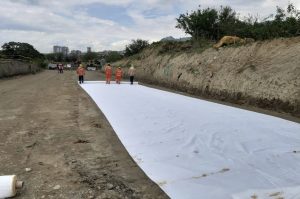
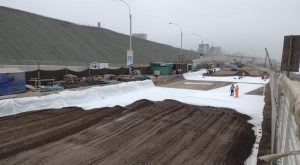
The high modulus PET geotextile is placed directly on the subgrade and covered with a layer of granular material, providing a basal reinforcement that creates an improvement layer in thick pavements or can constitute the subbase layer in low traffic pavements.
The key mechanism is the mobilization of tension in the plane of the geotextile, generating a tensioned membrane effect when the subgrade attempts to deform.
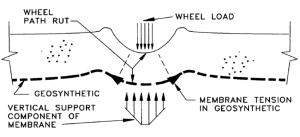
Technical criteria to justify its use
The use of high modulus PET geotextiles is technically justified when:
-
The CBR is less than 3%.
-
Excessive initial deformations are expected during construction.
-
The subgrade presents high variability in its natural moisture throughout the seasonal cycle.
-
The required thickness of granular improvement material is technically or economically high.
Increased granular thickness or geotextile high modulus?
Increasing the thickness of the granular layer is the traditional solution. However:
- Increases excavation and transportation costs.
- It does not eliminate the risk of contamination by mixing.
- It may not be efficient if the subgrade is extremely soft.
PET high modulus geotextile, on the other hand:
- Reduces the required thickness.
- Improves stability during construction.
- Controls fines intrusion.
- Optimizes long-term performance.
However, it does not completely replace the demand for structural thickness; it is a supplement that improves the efficiency of the system.
Common errors in specification
Some common errors include:
- Specify geotextiles based only on ultimate strength and not on modulus at low deformations.
- Use low-stiffness nonwoven geotextiles when reinforcement is required.
- Failure to consider saturation conditions in the design.
- Assume that any geotextile automatically improves the CBR.
- Omitting quality control in the installation (wrinkles, equipment damage, lack of adequate overlaps).
Performance depends on both the material and its correct installation.
Practical recommendations
- Perform a complete geotechnical characterization (CBR, Atterberg limits, resilient modulus, expansion tests).
- Analyze unfavorable humidity scenarios.
- Verify the modulus of the geotextile at low deformations.
- Design the system as a composite structure, not as independent layers.
- Evaluate the cost-benefit analysis versus the increase in granular thickness.
Conclusion
High modulus PET geotextiles are an effective tool in subgrades with CBR less than 3%, where deficiencies in bearing capacity, bearing capacity, long-term deformation under static and dynamic loading, and drainage conditions need to be addressed.
In road infrastructure, the key is not to add more layers, but to design systems that work in an integrated and efficient manner.