





When to use a reinforced soil wall and when not to use a reinforced soil wall?
The reinforced soil walls are flexible containment systems that combine a compacted backfill with reinforcement elements, generally geosynthetic or metallic. Their performance depends directly on the quality of the backfill material, compaction control and proper water management.
They are a widely used solution in road infrastructure, high slopes, urban areas and landfills on soft soils, They are not appropriate in all cases, however, and their selection should be based on their economy, flexibility and speed of construction. However, they are not appropriate in all cases, and their selection should be based on geotechnical, spatial and hydraulic conditions specific to the project.
RECOMMENDED USES
Road projects
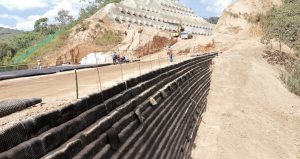
Reinforced soil walls are particularly suitable for road projects where the following are required cost-effective and fast-building retaining structures. They work well in road widening, embankment shaping and stabilization of moderate cuts. Its structural flexibility allows the absorption of differential settlements without compromising the overall stability of the system, which represents an advantage over rigid solutions such as concrete walls.
High slopes
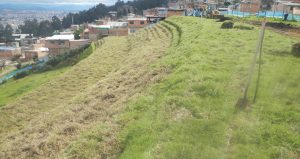
In high slopes, reinforced soil walls can be more efficient than conventional concrete walls, They reduce the costs associated with deep foundations. In addition, they allow to scale significant heights without proportionally increasing the cost of the system. Its deformable behavior also favors a better performance in the face of seismic actions, thanks to the interaction between the soil and the reinforcement.
Urban areas
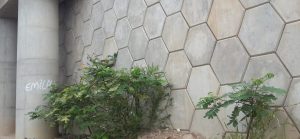
In urban contexts, these systems are particularly useful when a structural solution is required that also has aesthetic flexibility. The availability of different types of façade - such as prefabricated panels, segmental blocks, gabions or vegetated facades- allows adaptation to architectural or landscape requirements without compromising the structural performance of the system.
Soft soils
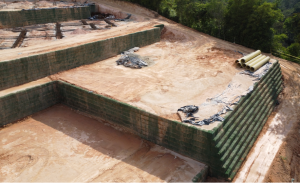
Reinforced floor walls can also be used on on soft soils, provided that the design adequately contemplates:
-
the expected deformations,
-
the evolution of settlements,
-
and the presence of water in the system.
In these cases it is essential:
-
strictly control the compaction of each layer,
-
apply preloads when necessary,
-
and ensure drainage systems that prevent the accumulation of interstitial pressures.
The system flexibility allows it to tolerate settlements that could be critical for rigid structures.
Construction speed
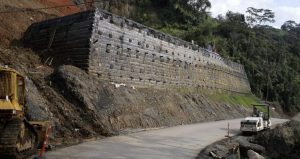
Another frequent reason for selecting a reinforced soil wall is its high construction speed. In contrast to concrete walls, these systems are no formwork or setting times required, This facilitates its implementation in projects with tight schedules or in works where operational traffic must be maintained and work must be carried out in short intervention windows.
Did you know that high tenacity polyester offers superior long-term performance?
Thanks to their low creep, the FORTGRID UX maintain their structural capacity for decades, reducing deformations under permanent loads and guaranteeing stability in designs of 75 to 120 years.
CASES WHERE ITS USE IS NOT RECOMMENDED
Space restrictions
Reinforced soil walls are not appropriate when there is a critical space constraint at the back of the wall.
The system requires a length of reinforcement that normally corresponds to approximately 70 % of structure height. This may make it unfeasible to build in:
-
limited properties,
-
densely urbanized areas,
-
or sectors with interferences such as buildings, networks or buried structures.
Lack of control of backfilling and compaction
When it is not possible to guarantee the quality of the backfill and adequate compaction control., The performance of the wall may be seriously compromised.
The strength of the system depends directly on the mechanical behavior of the backfill material. For this reason, the construction of reinforced soil walls is not recommended in environments where:
-
there is no adequate geotechnical supervision,
-
o there are operational limitations to achieve proper compaction.
Inadequate backfill materials
Reinforced soil walls should not be constructed with backfill composed of heterogeneous materials., such as:
-
garbage,
-
organic soils,
-
contaminated soils,
-
or mixtures with undefined mechanical properties.
Soil-reinforcement interaction depends on well-characterized parameters of the backfill material. When these conditions cannot be guaranteed, it is necessary to replace material or consider another type of structural solution.
Did you know that it is not designed with the ultimate strength but with the allowable strength?
Creep reduction, installation damage and chemical degradation factors are applied in the geotechnical design. This ensures that the geogrid will perform safely throughout the life of the project.
CONCLUSION
The selection of a reinforced soil wall should be based on a comprehensive analysis of:
-
geotechnical conditions,
-
space restrictions,
-
structural requirements,
-
and the operational needs of the project.
This is a solution efficient and competitive when flexible containment, high construction speed and good performance in soils with moderate settlements are required.
However, it is not suitable in scenarios where:
-
the rear space is insufficient,
-
water control is limited,
-
o a rigid structural response with minimum deformations is required.
For this reason, correctly assessing the type of soil, the available geometry and the expected behavior of the structure is essential to determine whether a reinforced soil wall is the appropriate alternative or whether the project requires a different containment system.