





Reinforced Soil Wall Standards
The walls in soil reinforced with geosynthetics are widely used in road, rail and water infrastructure projects due to their technical and economic efficiency.
However, their design and construction must comply with a regulations for reinforced soil walls that guarantees stability, safety and durability.
In this article we analyze the main guidelines applicable in Colombia, their relationship with international codes and the regulatory landscape in Latin America.
Regulations for Reinforced Soil Walls in Colombia
1️⃣ INVIAS Technical Specifications
He Article 687 of the INVIAS General Specifications for Road Construction is the main normative document for road works incorporating reinforced soil walls.
This article regulates:
-
Types of walls with geogrids, geotextiles or metal reinforcements.
-
Minimum requirements for filler materials.
-
Compaction criteria and quality control.
-
Conditions for front facing, drainage and erosion protection.
-
Construction guidelines and on-site acceptance criteria.
It has a mandatory contractual nature in projects financed or executed under the INVIAS framework.
2️⃣ CCP-14 - Colombian Code of Bridges
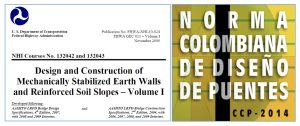
He CCP-14 (Colombian Bridge Code) is applicable to the design of reinforced soil walls when they are part of:
-
Bridge access structures
-
Abutment walls
-
Containment works associated with major road infrastructure
This code, conceptually aligned with AASHTO LRFD, states:
-
Global, internal and external stability criteria.
-
Consideration of permanent loads, traffic and seismic effects.
-
Safety factors and geotechnical limit states.
-
Soil-structure interaction requirements.
In practice, CCP-14 is used as the structural and geotechnical design framework, while Article 687 regulates construction execution.
International References for MSE Walls
Since Colombian regulations do not develop in detail the specific design of MSE (Mechanically Stabilized Earth) walls, it is common to complement with international references such as:
-
FHWA-NHI-10-024: Design and Construction of Mechanically Stabilized Earth Walls and Reinforced Soil Slopes.
-
AASHTO LRFD Bridge Design Specifications (containment chapters).
-
ISO and ASTM standards for geosynthetics.
-
Manufacturers' technical manuals, supported by calculation memories.
These documents must conform to the requirements of CCP-14 and the project contract specifications.
Reinforced Floor Walls Regulations in Latin America
Although regulation varies from country to country, there are common trends in the adoption of international standards.
Chili
Applies the Highway Manual and INN standards, with emphasis on seismic design for high seismicity.
Mexico
The SCT regulations and the Building Regulations establish parameters for retaining walls, considering dynamic loads and drainage.
Peru, Ecuador and Brazil
Adopt AASHTO LRFD guidelines supplemented with local standards.

Technical Recommendations for Regulatory Design
To ensure compliance in the design of geosynthetic reinforced soil walls, it is recommended:
✔ Verify regulatory compatibility between local regulations and international standards.
✔ Incorporate seismic analysis in high hazard areas.
✔ Design efficient and redundant drainage systems.
✔ Implement quality control through soil testing and verification of geosynthetic reinforcement.
Conclusion
The correct application of the regulations for reinforced soil walls is essential to ensure structural stability and long-term performance.
In Colombia, Article 687 of INVIAS and the CCP-14 constitute the main framework, complemented by international standards such as AASHTO and FHWA for detailed design.
A comprehensive regulatory approach enables the development of safer, more efficient and technically sound walls.