





How to improve low CBR subgrades using geosynthetics
Improvement of subgrades with low CBR
Improving subgrades with low CBR is a frequent challenge in pavement design and construction, due to the risk of premature deformation and failure.
In the design and construction of pavements, the presence of subgrades with low CBR represents one of the main technical challenges, since this implies the appearance of deformations and premature failures. Faced with this scenario, the use of geosynthetics has established itself as an efficient solution to compensate for the structural performance of the pavement without resorting to extensive soil replacement.
Subgrades with low CBR can be improved by the use of woven geotextiles high-modulus polyester fabrics, which act as structural reinforcement elements by interacting with the subgrade and granular layers. Thanks to their high tensile modulus and low long-term deformation, these geosynthetics mobilize tensile stresses from the first deformations of the soil, thus improving load distribution, confining the granular material and reducing vertical deformations. As a result, the the effective CBR of the improvement system., without the need to replace the existing subgrade (See Figure 1).
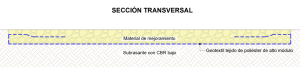
Figure 1. Schematic diagram of high modulus polyester geotextile installation for CBR improvement.
WHAT DOES IT MEAN TO HAVE A LOW CBR SUBGRADE?
He California Bearing Ratio (CBR) is an indicator of the bearing capacity of the soil against applied loads. Low CBR values are associated with soils with low shear strength, high deformability and sensitivity to moisture, conditions that hinder adequate load transfer to the foundation soil.
HOW DO HIGH MODULUS WOVEN GEOTEXTILES PERFORM?
- Reinforcement and improvement of support capacity
The geotextile controls the failure envelope of the system by confining it within the higher strength granular layers. This increases the stiffness of the assembly and reduces the deformations of the foundation soil.
- Tensed membrane effect
When a load is applied, the deformation of the subgrade stresses the geotextile, whose vertical component contributes to redistribute the stresses and reduce the load transmitted to the soft soil.
- Separation and containment
The geotextile prevents contamination of the granular layer by intrusion of fines, preserving its drainage and structural performance from the construction stage.
WHY USE HIGH MODULUS POLYESTER GEOTEXTILES?
Polyester woven geotextiles feature:
- High tensile modulus under cyclic and monotonic loading
- Low long-term deformation (mechanical stability under permanent loads)
- High durability in contact with aggressive soils
- Hydraulic stability in any condition of stress or confinement.
These properties ensure early mobilization of reinforcement and reliable long-term performance.
MAIN BENEFITS
The use of high modulus woven geotextiles allows:
- Increase system support capacity
- Reduce thicknesses of granular layers
- Minimize failures during construction
- Optimize costs and execution times
- Increases the service life of the structure
CONCLUSION
The use of high modulus polyester woven geotextiles constitutes a technically robust solution to improve the performance of subgrades with low CBR. Through reinforcement, confinement and tensioned membrane mechanisms, these geosynthetics allow increasing the effective CBR of the soil-pavement system, optimizing the structural design, reducing costs, facilitating construction and guaranteeing a reliable long-term performance.