





Geotextile pipes in hydraulic engineering
Geotextile Pipes in Hydraulic Engineering: definition, operation mechanisms and applications.
In the modern hydraulic engineering, The search for solutions that combine structural efficiency with sustainability has driven the use of advanced geosynthetics. Among them, the geotextile pipes in hydraulic engineering (or tubular geocontainers) have established themselves as a versatile technology for river protection, erosion control and environmental sludge management.
Below, we explore what they are technically, how they work and their main applications in hydraulic works.
What are geotextile tubes?
Technically, geotextile tubes are large-volume confining systems made of high-tenacity polyester woven geotextiles. These textiles are designed with specific filtration and tensile strength properties to withstand high internal pressures during pumping, allowing water to pass through while retaining solids inside.
Unlike a conventional bag, a geotextile tube acts as a monolithic gravity structure once consolidated, making it an efficient solution in hydraulic projects.
Mechanism of operation of geotextile tubes: three-phase cycle
The operation of the geotextile tubes in hydraulic engineering is based on a simple but highly effective hydraulic principle, divided into three critical stages:
1. Confinement (Filling)
A fluid mixture (water and sand or mud) is pumped into the pipe through filling ports. The geotextile acts as a permeable membrane that confines solids.
2. Dewatering
Thanks to the controlled permeability of the fabric, free water dissipates through the pores of the geotextile, while solid particles are trapped.
In applications of industrial sludge dewatering, flocculant polymers are often added to accelerate phase separation and improve process efficiency.
3. Consolidation
With the loss of water, the volume of the pipe is reduced and the internal material becomes denser, forming a solid and stable structure capable of supporting external loads or acting as a physical barrier.
Geotextile pipe applications in hydraulic works
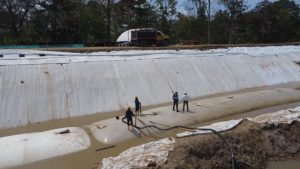
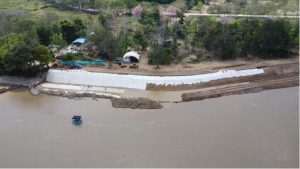
1. Erosion control and coastal protection
In this scenario, the pipes are generally filled with sand from the site, acting as a structural core for various hydraulic solutions:
-
Breakwaters and jetties: dissipate wave energy and modify sediment transport.
-
Bank revetment: protects river and canal banks against scour.
-
Check dams: create dry enclosures or flood defense structures.
2. Sludge dewatering (Dewatering)
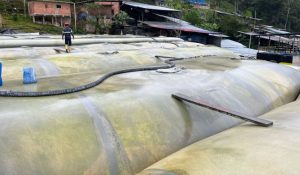
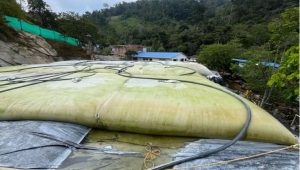
In this case, the main objective is not to build a structure, but to reduce the volume of waste and facilitate its disposal or reuse:
-
Industrial and mining sludge management.
-
Cleaning of oxidation ponds and contaminated canals.
-
Recovery of valuable solids in production processes.
Why use geotextile pipes in hydraulic engineering?
The implementation of geotextile tubes offers clear technical advantages over traditional methods such as riprap or rip-rap:
-
Use of local materials: allows the use of sand or sludge from the same site, reducing transportation costs.
-
Speed of installation: they can be deployed and filled in situ much faster than rigid concrete structures.
-
Lower environmental impact: they reduce the carbon footprint associated with transportation and, in some cases, allow for revegetation and landscape integration.
Conclusion
The geotextile pipes in hydraulic engineering represent an efficient solution that leverages the principles of soil hydraulics to solve large-scale erosion control and sludge dewatering problems.
Whether to protect a coastline, stabilize a riverbank or manage industrial waste, their ability to separate solids and liquids makes them a strategic tool in contemporary water infrastructure.