





Reinforced soil walls in areas with flooding potential
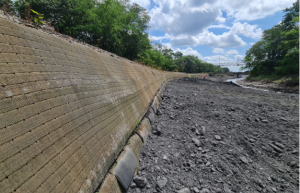
The walls in reinforced soil in areas with flooding potential are a widely used solution in road, urban and hydraulic infrastructure projects. However, when these walls are located in areas with high water tables or flood risk, the design must incorporate more demanding hydraulic, geotechnical and durability criteria.
Here are five fundamental tips for the design and construction of reinforced soil walls under flood conditions.
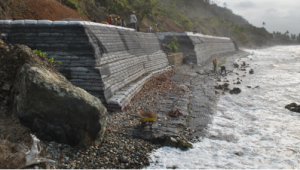
Efficient and redundant drainage system
Water increases the thrusts and reduces the resistance of the soil, increasing the deformability of the soil-geosynthetic assembly. Therefore, it is essential to design a robust drainage system that includes:
-
Drainage layers with granular material
-
Use of draining granular material in the formation of the wall.
-
Perforated pipes protected with FORTEX geotextiles, which act as filters, preventing the migration of fines
-
Redundant drains to ensure operation during extreme events.
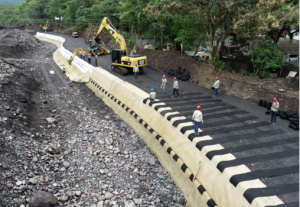
2. Proper selection of geotextiles and geogrids
In walls in reinforced soil in areas with flooding potential, The reinforcements must retain their mechanical properties even under prolonged saturation.
-
The FORTEX geotextiles offer high permittivity and permeability, reducing pore pressures and ensuring durability in humid environments
-
The FORTGRID geogrids provide high tensile strength and excellent soil-reinforcement interaction, making them ideal for walls subjected to hydraulic loads.
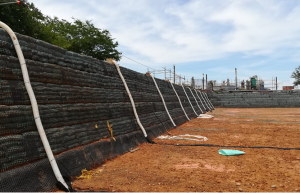
3. Erosion and scour protection
During flood events, the velocity of the flow can generate scour at the base of the wall. To mitigate this risk it is recommended:
-
Protect the footing of the wall with draining mats or mattresses.
-
Consider adequate embedment in the natural terrain.
-
Use FORTEX geotextiles as a separating layer to avoid the loss of fine material
- Evaluate the maximum flood level and expected flow velocities.
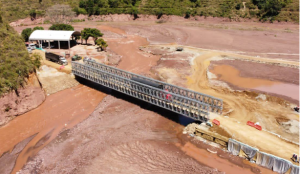
4. Analysis of the wall in saturated condition
The design should contemplate critical scenarios associated with saturation, including:
-
Active thrusts with saturated soil
-
Reduction of soil resistance parameters
-
Verification of internal, external and global stability, taking into consideration the structural contribution of the FORTGRID geogrids
This analysis is key to ensure the safety of the wall during extreme hydraulic events.
5. Design of the facing with hydraulic criteria
The wall facing should facilitate the dissipation and evacuation of water. For this purpose it is recommended:
-
Use modular systems with drainage joints
-
Incorporate geotextiles FORTEX behind the facing to facilitate drainage
-
Design the facing to resist the impact of floating elements transported by the current.
Conclusion
The walls in reinforced soil in areas with flooding potential can perform safely and efficiently if they are integrated from the design stage. FORTEX geotextiles, FORTGRID geogrids and appropriate hydraulic and geotechnical criteria.
A preventive approach ensures greater stability, durability and long-term safety, even in demanding hydraulic scenarios.