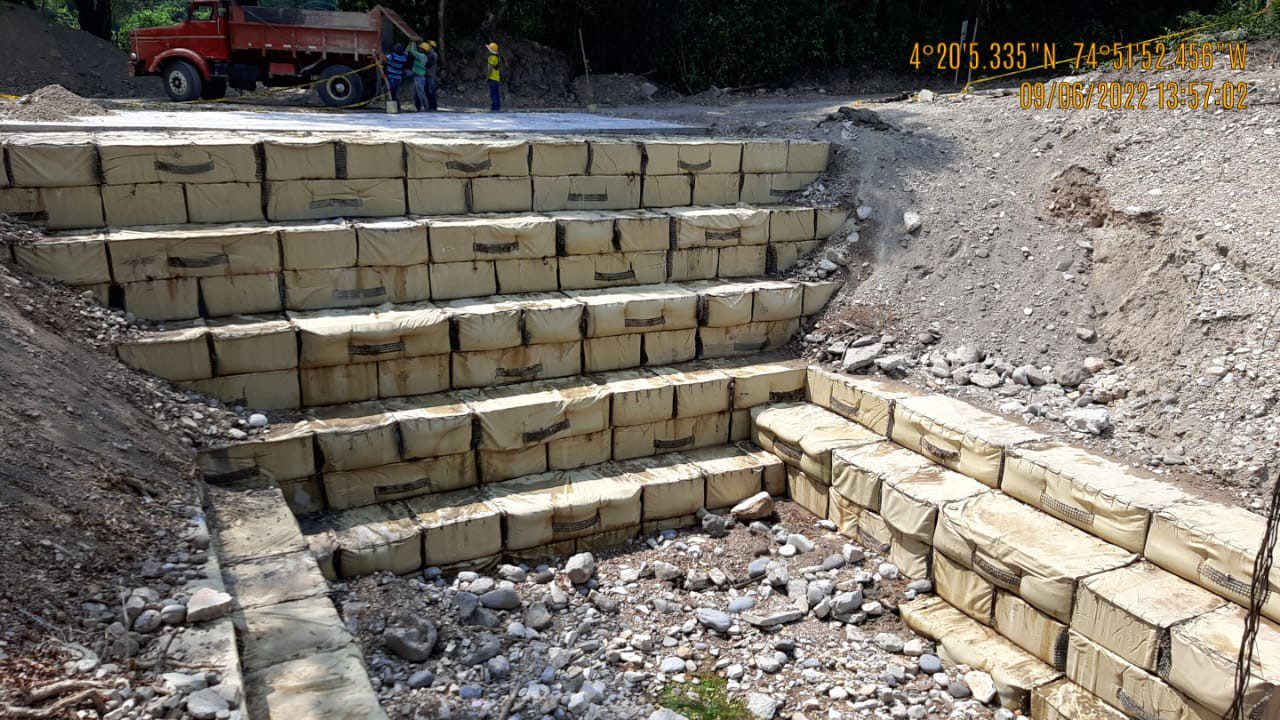


Protection of areas prone to lateral erosion or reconformation with HYDROBLOCK STRUCTURAL GEOCONTAINERS
During a winter event, the drag forces of the water can increase significantly, which can lead to atypical values for shear stress, velocity, and an increase in the normal flow depth. These parameters can result in lateral erosion along the channel banks, a natural phenomenon involving the removal, transport, and deposition of soil particles. To protect against this erosion, the construction of gravity structures is recommended using HYDROBLOCK GEOCONTAINERS.
To protect areas prone to lateral erosion or to reshape them, it is recommended to construct gravity structures using on-site soil, confining it within the HYDROBLOCK STRUCTURAL GEOCONTAINERS, as can be seen in the following photographs.

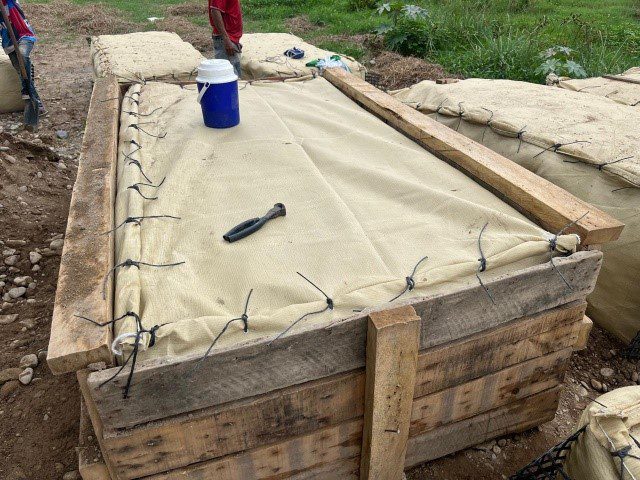
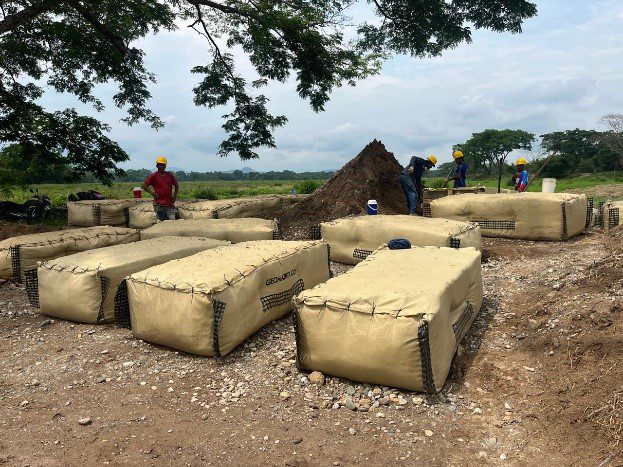
The HYDROBLOCK STRUCTURAL GEOCONTAINERS are assembled using IMPREGNATED WOVEN GEOTEXTILE, a material that is highly resistant to UV rays and abrasion, making it durable for long-term outdoor use. The HYDROBLOCK They are designed to be filled mechanically or hydraulically on site for dry structures, although they can also be hoisted using slings for the construction of submerged structures.
As each unit is filled, it forms a large rectangular modular element with significant mass and volume, which is used to construct gravity-based shoreline protection structures, since its capacity of 1.45 m³ corresponds to a weight of approximately 3 tons. The units are arranged in layers following a staggered pattern to ensure stability and are joined together at their corners using geogrid ties secured with Geocable.
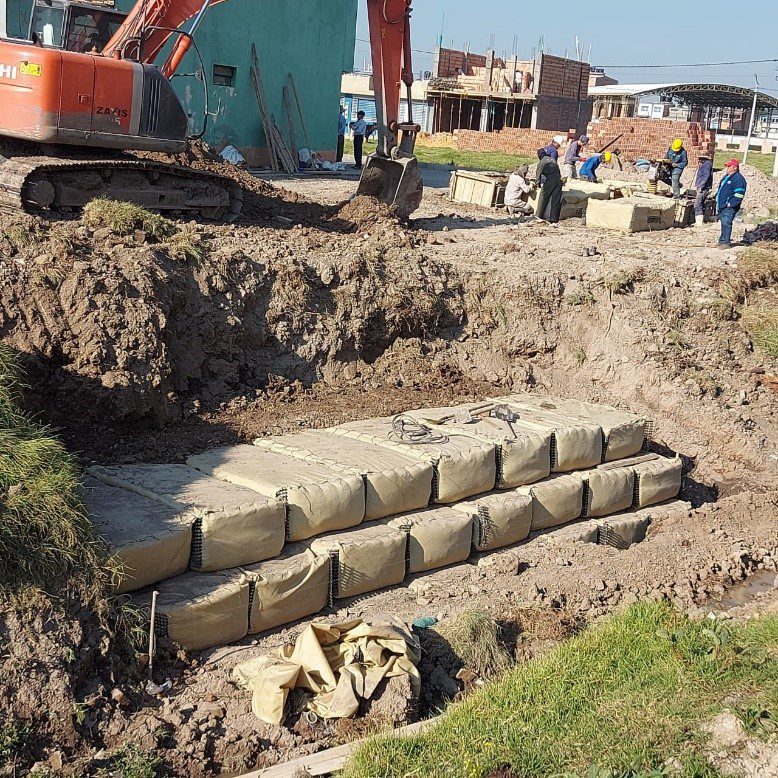
From an installation standpoint, theyou STRUCTURAL GEOCONTAINERS HYDROBLOCK are highly versatile and resistant to installation damage, as the geotextile thas high tensile strengthtearing and puncturing. In addition, they feature a closure system using straps with geocable, designed so that it controls the migration of fine particles from the element to the get in in contact with water, guaranteeing air tightness. Likewise, since iimpregnated, improves its mechanical and hydraulic properties managing to be more weather-resistant and naturally harsh, humid environments.