





Foundations for fuel tanks in Corinto, Nicaragua
The fuel tank foundations is a critical aspect in industrial projects developed on soils with low bearing capacity. In Corinto, Nicaragua, a fuel tank foundation reinforcement project was carried out using soil improvement techniques that guarantee structural stability and long-term operational safety.
Geotechnical challenges in fuel tank foundations
Subsurface conditions represented a major challenge for the design of the storage tank foundations. The low strength of the natural soil, combined with the presence of groundwater, demanded a specialized engineering solution that would allow:
-
Increasing the carrying capacity of the land
-
Reducing differential settlements
-
Ensure the structural and operational stability of the tanks
-
Ensuring reliable long-term performance
Reinforcement solution for fuel tank foundations
To improve the soil, a system was implemented to replace the natural material with stone aggregate, reinforced with interlayers of high modulus woven geotextile. FORTEXacting as reinforcement and confinement elements.
At the bottom of the excavation, a layer of 20 to 40 cm boulders was placed, compacted with heavy equipment to achieve adequate intrusion into the natural soil. Five 25 cm layers of selected granular material were placed on top of this base, each one reinforced with FORTEX BX1130 geotextile, which laterally wrapped the backfill to provide confinement and lateral stability.
A layer of cement-stabilized granular material was built on top of the system to support the ring beam of the tank foundations.
The implemented solution demonstrated that the fuel tank foundations reinforced with high modulus geotextile is an efficient alternative for low bearing capacity soils.
Structural performance of reinforced fuel tank foundations
High-modulus woven geotextile layer arrangement FORTEX, The foundation pad, integrated with granular material, forms a foundation pad that behaves structurally as a footing with a larger effective area, on which the foundation beam of the structure rests.
Compared to an unreinforced material replacement, this system features:
-
Increased load capacity
-
Reduced deformations
-
Settlement reduction
-
Better distribution of efforts
The tensile strength contribution of FORTEX geotextile increases the shear strength of the soil-fill assembly, decreases the deformation of the system and significantly improves the bearing capacity. This behavior is directly related to its high modulus of deformation, its tensile strength and its long-term stability against creep phenomena.
Photographic record of the construction process
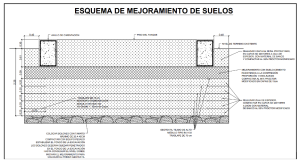
Figure 1. Schematic diagram of foundation reinforcement with FORTEX® geotextile.
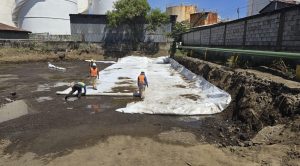
Photograph 1. Laying of the geotextile FORTEX
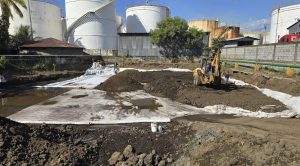
Installation of granular material over the FORTEX high modulus geotextile.
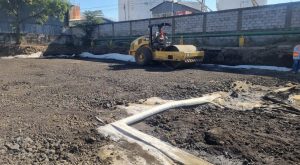
Photograph 3. Compaction of granular material.
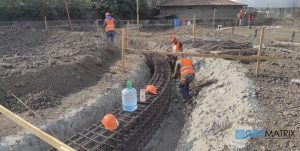
Photograph 4. Construction of the storage tank foundation beam.
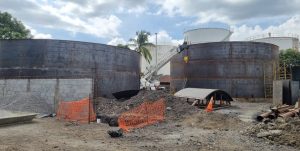
Photograph 5. Improved above-ground metal structure storage tanks.
This project confirms that the fuel tank foundations reinforced with high modulus woven geotextile is an efficient solution to control settlement and improve bearing capacity in complex soils.