




Geotextile tube, characteristics, concepts, materials and aspects of analysis
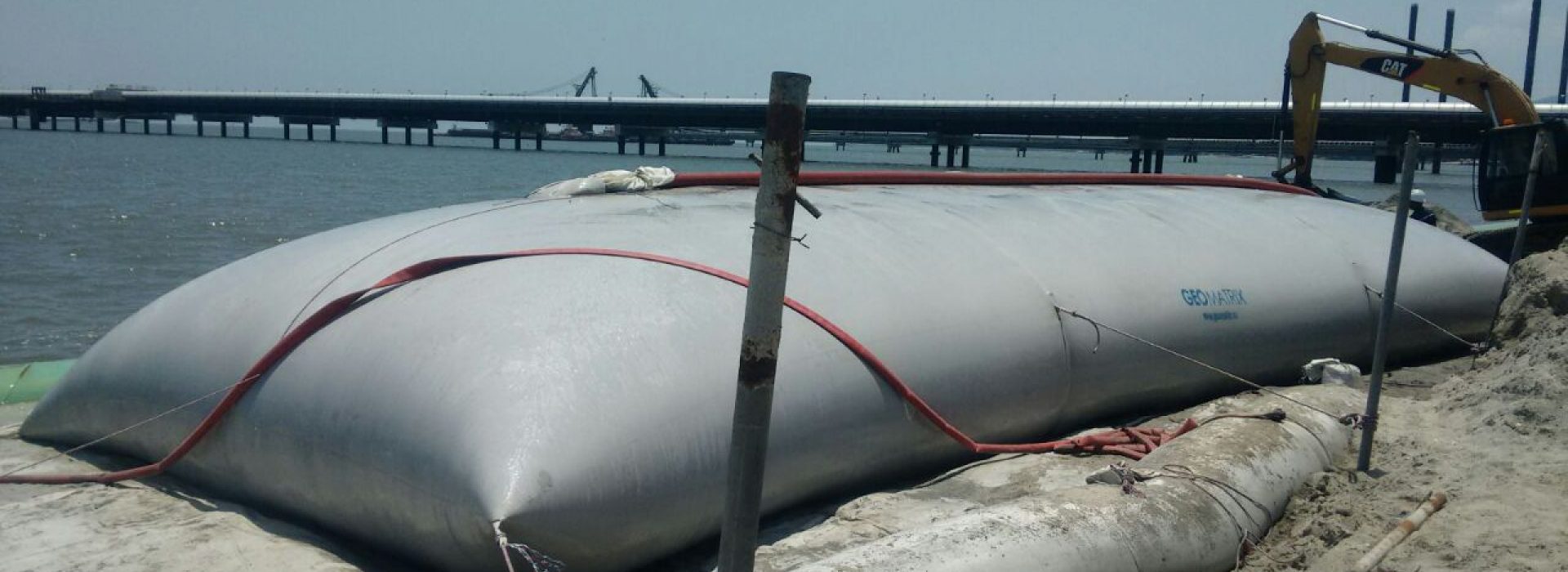
Marine and river hydraulic projects sometimes require the construction of unconventional structures, which can be built quickly and easily. Among this type of structures are geotextile tubes or geotubes, as they are also known, which are elongated cylindrical containers that are manufactured with strips of high-resistance woven geotextiles sewn together. The geotextile tubes are taken empty and in individual packages to the construction site, where they are arranged according to the hydraulic design to be filled, using suction and pumping equipment, with a mixture of soil and water at a certain pressure. Geotextile tubes imply a high level of both mechanical and durability requirements, which is why high-tenacity PET polyester woven geotextiles have a fundamental field of application there, given their high tensile strength, high deformation modulus and low creep. under long-term sustained load.
Generally, geotextile tube projects are designed to be built quickly, simply, and economically from site material, supported by natural ground. However, geotextile tube projects are built where the material for filling has to be transported to the construction site; in other cases, the pipes, after being filled, are released into the bed from split-bottom barges. The cross-sectional shape of a geotextile tube is oval and the height and width that they reach depend directly on their perimeter and the filling pressure. The length is limited by the filling capacity or by logistic factors, such as the weight of the empty tubes or the geometry of the structure.
In the development of this document, number 2 provides a detailed description of each of its parts, along with the main characteristics that the geotextile must have. Numeral 3 presents a methodology for the analysis of geo-textile tubes based on the works of Liu (1981), Kazimierowicz (1994) and Carroll (1994), where the basic formulations and conditions for numerical modeling are recorded. . In numeral 4, an analysis of trends is presented through graphs of the behavior of the geometry with respect to the variation of the filling pressure or the perimeter of the geotextile tubes, from which, finally, related recommendations are proposed. with the design and filling.