




Geotextiles vs. geogrids: Reinforced soil walls
The reinforced soil walls are an efficient solution in geotechnical engineering for stabilizing slopes and retaining structures. In these systems, reinforcement materials play a key role, and the two most common alternatives are the geotextiles and the geogrids.
In this article we analyze the main differences between geotextiles vs. geogrids in reinforced soil wallsconsidering its structural performance, construction conditions and durability, in accordance with the guidelines of the FHWA.
Structural function and reinforcement mechanism
Both geotextiles and geogrids work on the same principle: to increase the shear strength of the soil through soil-reinforcement interaction.
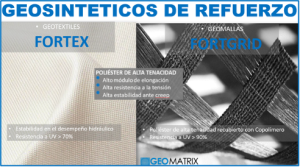
The FORTEX® woven geotextiles offer frictional and adhesion resistance over their entire surface, acting as a continuous sheet that confines the soil and distributes stresses. Their high modulus of elongation guarantees an efficient response to low deformations.
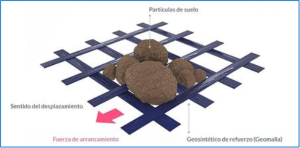
For their part, the FORTGRID UX geogrids work mainly by mechanical jamming with the soil particles or granular material, generating a rigid and direct connection with the ground. Its double interaction by friction and interlocking significantly increases the efficiency of the reinforcement.
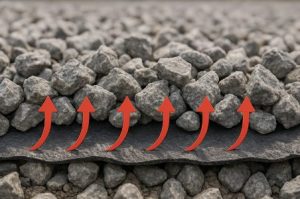
For their part, the geogrids operate primarily through the mechanical jamming with the soil particles or granular material. This direct contact creates a more rigid and stable connection, which is ideal for walls of great height or with high loads. In the case of FORTGRID UX geogridsIn addition, an additional benefit is obtained thanks to the combination of friction and stiffening, which increases the efficiency of the reinforcement.
Soil type and site conditions
The choice between geotextiles and geogrids depends on the type of soil and construction conditions.
The woven geotextiles are more versatile and easy to install, ideal for fine or low granulometry soilswhere separation, reinforcement and filtration are required simultaneously.
The geogridsinstead, they offer better performance with granular fillersachieving greater control of deformations and stability in high walls.
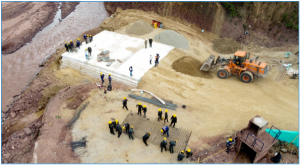
On the other hand, the geogrids show better performance with granular or selected fillersThe interlocking between the particles is more effective, providing greater rigidity and control of lateral deformations.
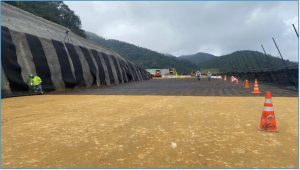
Ease of installation and cost
In terms of installation, the geotextiles are more flexible and adapt easily to uneven terrain. The geogridsThe stiffness of the material requires a level surface, but they provide greater structural stability once integrated into the soil.
In terms of costs, the woven geotextiles are usually more economicalwhile the FORTGRID geogrids investment, which is offset by a higher investment improved structural performance in highly demanding projects.
Durability and long-term performance
Both materials have excellent resistance to chemical and biological degradation.
The FORTGRID geogrids The co-polymer coating provides greater stiffness and durability, while the FORTEX geotextiles offer continuous interaction with the soil, favoring drainage and erosion control.
Thanks to its manufacture with high tenacity polyester fibersboth products have an outstanding creep resistance (creep)The use of polypropylene and high-density polyethylene is a major advantage of this material.
Conclusion
In summary, the woven geotextiles FORTEX are ideal for low or medium-height reinforced soil wallswhere a solution is sought flexible, economical and efficient.
On the other hand, the FORTGRID geogrids are the best option for structurally demanding wallsThe construction of these structures, built with granular backfills, in which the deformation control and durability are key factors.
The choice between geotextiles vs geogrids should be based on soil type, wall height, design loads and job site conditions, always supported by a detailed geotechnical analysis.